Natural Language Interfaces: How They Work
How Natural Language Interfaces use NLP, ML, and LLMs to turn plain English into website updates, boosting accessibility and efficiency.
Natural Language Interfaces: How They Work
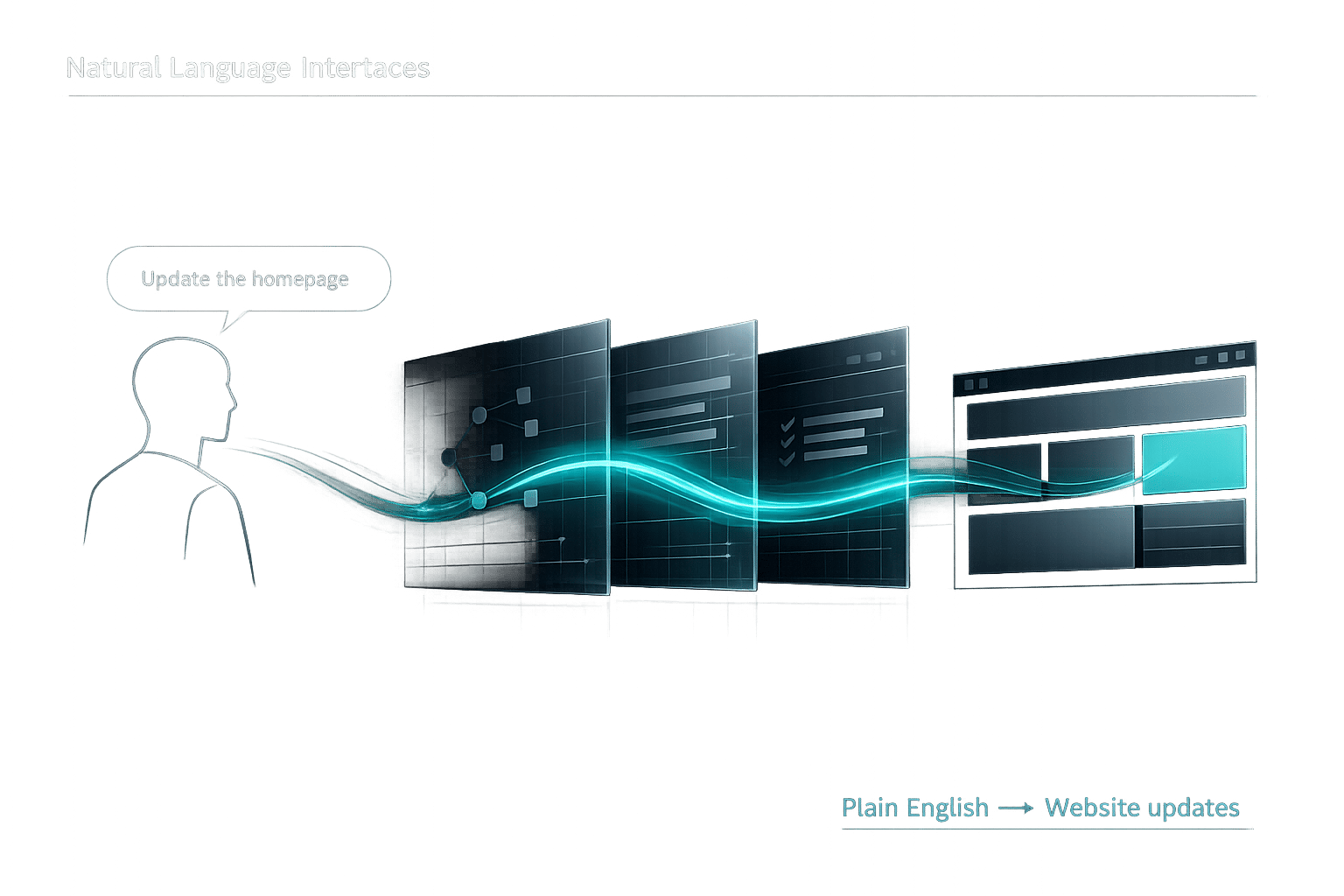
Natural Language Interfaces (NLIs) let you interact with computers using plain language. Instead of coding or navigating menus, you simply describe what you need, like "Change the header color to blue", and the system handles it. These tools simplify web customization, making it faster and more accessible for everyone.
Key Points:
- What NLIs Do: Turn everyday language into actionable commands.
- How They Work: Use technologies like Natural Language Understanding (NLU), Machine Learning, and Large Language Models (LLMs) to process and respond to user input.
- Why They Matter: They save time, reduce technical barriers, and improve accessibility for non-technical users.
- Real-World Example: Platforms like Kintsu.ai allow WordPress users to update websites conversationally without coding.
By combining advanced AI with user-friendly design, NLIs are reshaping how we manage websites, making tasks simpler and more efficient.
Natural Language Interfaces to Software with GPT-4o Function Calling
How Natural Language Interfaces Work
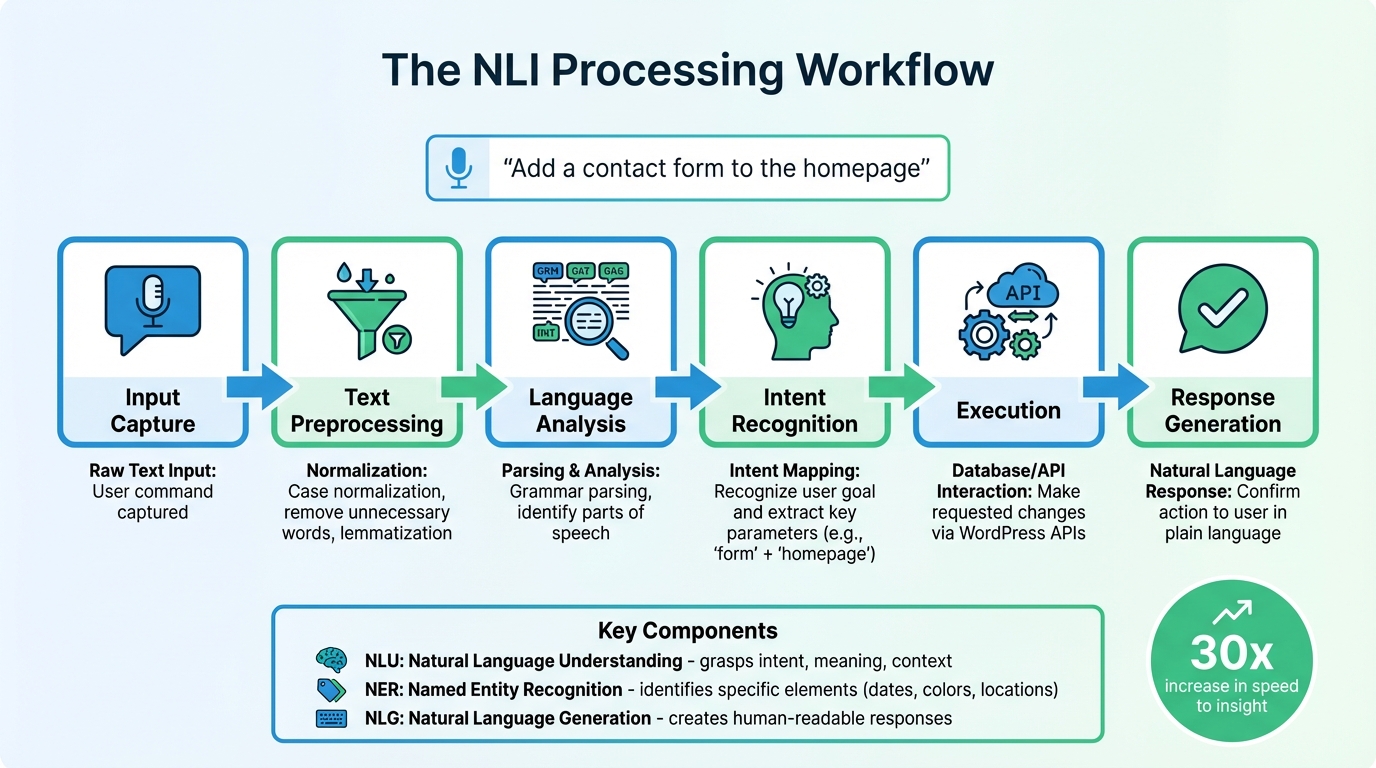
How Natural Language Interfaces Process User Commands: A Step-by-Step Workflow
Core Components of NLIs
Natural Language Interfaces (NLIs) rely on several interconnected parts to interpret and act on user requests. At the heart of this process is Natural Language Understanding (NLU), a branch of Natural Language Processing (NLP) focused on grasping intent, meaning, and context.
Key steps include tokenization and embedding, where text is broken into smaller pieces (tokens) and converted into numerical representations. Then, Named Entity Recognition (NER) identifies specific details like dates, colors, or locations. For instance, in the command "Change the header to blue", NER pinpoints "header" and "blue" as actionable elements.
Intent recognition plays a crucial role by figuring out what the user wants to achieve, even when similar words appear in different contexts. Dialogue management ensures the system remembers the flow of the conversation, so users don’t have to repeat themselves. Lastly, Natural Language Generation (NLG) translates the system’s decisions into responses that make sense to humans.
Together, these components create a seamless process that transforms plain language into meaningful web actions.
The Processing Workflow
Using these components, NLIs follow a structured workflow to handle user commands. Imagine you say, "Add a contact form to the homepage." The system processes this request step by step. It starts by capturing your input as raw text, then cleans it up by normalizing case, removing unnecessary words, and applying lemmatization.
Next, the system dives into language analysis, parsing grammar and identifying parts of speech. It maps your intent and extracts key parameters - recognizing that you're asking to place a form on the homepage. From there, the NLI interacts with databases or APIs to make the requested change.
This kind of workflow has proven its efficiency in other areas too. For example, marketing platforms using similar processes have achieved a 30x increase in speed to insight. The same technology powers tools for web customization, turning conversational inputs into precise, real-time updates for your site.
Technologies Behind Natural Language Interfaces
Natural Language Processing (NLP) and Machine Learning
NLP acts as a bridge between human communication, which is often unstructured, and the structured data that computers rely on to function. This technology allows machines to understand and respond to human language effectively. Machine learning plays a crucial role here, helping NLP identify patterns that traditional rule-based systems simply can't manage. To make raw text usable, NLP employs preprocessing techniques like tokenization (breaking text into smaller units) and lemmatization (reducing words to their base forms).
Modern machine learning models go a step further, learning not just the meaning of words but also their context and emotional tone from massive datasets. Through transfer learning, these models can be fine-tuned for specific industries, such as adapting to WordPress-related terminology.
"The rule-based evaluation is mainly in the realm of correctness, whereas models tend to be used for the more subjective types of changes." - Alice Kaiser-Schatzlein, Analytical Linguist, Grammarly
These foundational technologies pave the way for even more advanced tools, like Large Language Models, which elevate natural language interfaces to the next level.
Large Language Models (LLMs)
Large Language Models represent the cutting edge of natural language interfaces. Trained on text data equivalent to over a million books, these models leverage transformer architectures to process and understand language. Examples like OpenAI's GPT-3.5 and GPT-4 use a mechanism called self-attention to grasp the relationships between words, enabling them to generate coherent and contextually relevant responses.
LLMs work by predicting the next token (a unit of text) based on patterns they've learned. In English, a token usually corresponds to about four characters, so 400 tokens translate to roughly 300 words. This probability-driven approach allows these models to handle complex tasks, such as customizing websites, while maintaining an awareness of the broader context.
This advanced understanding of language makes LLMs a natural fit for integrating with web management platforms.
Integration with Platforms Like Kintsu.ai
The advancements in natural language technologies have made intuitive web customization a reality. Integrating natural language interfaces with platforms like Kintsu.ai requires three key components: a reasoning model (such as an LLM), tools like APIs or external functions, and clear instructions with built-in safeguards. In this framework, the LLM interprets user input and makes decisions, while APIs handle the actual implementation of changes.
As OpenAI describes it:
"Agents are systems that independently accomplish tasks on your behalf." - OpenAI
Kintsu.ai leverages these technologies to enable conversational WordPress management. By using LLMs to understand user intent, execute changes via WordPress APIs, and provide feedback in natural language, the platform simplifies website updates. This process eliminates the need for coding, allowing users to make sophisticated adjustments to their sites through straightforward conversation.
sbb-itb-42d7c06
Benefits of Natural Language Interfaces for Web Customization
Natural language interfaces (NLIs) bring a fresh approach to web customization, making the process smoother and more inclusive.
Better User Experience and Accessibility
NLIs simplify web management by letting users make updates through plain language. Instead of memorizing complex navigation paths or learning technical syntax, users can simply describe what they want, and the system handles the rest.
This is a game-changer for accessibility. A 2022 WebAIM report revealed that 97% of the top 1,000,000 homepages have accessibility errors, leaving approximately 1.3 billion disabled individuals globally at a disadvantage. NLIs address this gap with features like hands-free operation and voice-activated controls, breaking down traditional barriers to navigation.
By reducing the cognitive load, NLIs make complex tasks more approachable. They break these tasks into smaller, manageable steps and ask clarifying questions when needed[36, 11]. As UXtweak explains:
"NLIs allow users to interact with systems in a way that feels natural and intuitive to them, reducing the learning curve typically associated with new technology".
This ease of use not only improves accessibility but also saves time and boosts efficiency.
Time Savings and Improved Efficiency
NLIs significantly cut down the time required for web updates, with some studies showing a reduction in response times by up to 77%. This is largely due to the elimination of navigation friction, allowing users to issue direct commands[41, 43].
For non-technical users, NLIs remove the need to rely on specialists for tasks like querying databases, updating content, or modifying layouts. Platforms such as Kintsu.ai demonstrate this by enabling WordPress users to make real-time changes just by describing their needs - no coding or complicated dashboards required.
By automating routine tasks, NLIs free up time for more strategic activities and reduce the need for extensive training[2, 11]. Additionally, the use of speech AI technologies has been linked to a 35% boost in customer satisfaction.
Standard Interfaces vs. NLIs
| Aspect | Standard Interfaces | Natural Language Interfaces |
|---|---|---|
| Ease of Use | Requires technical knowledge | Intuitive - no coding needed |
| Speed | Slower due to manual processes | Faster with real-time updates |
| Accessibility | Barriers for non-technical users | Accessible to all users |
| Customization | Requires coding expertise | Simple language-based updates |
Standard interfaces often demand a high level of technical know-how, requiring users to manually locate features and execute tasks. NLIs, on the other hand, understand user intent and context, delivering tailored outcomes seamlessly[41, 11]. As Fuselab Creative puts it:
"AI has changed the script of accessibility in UX design from 'How do we make this accessible after we build it?' to 'How can AI help us build this inclusively from the start?'".
This comparison highlights how NLIs are reshaping web customization, making it more intuitive, efficient, and inclusive than ever before.
Conclusion
Main Takeaways
Natural language interfaces (NLIs) are breaking down technical barriers, making advanced web customization as simple as having a conversation. Instead of navigating complex menus or writing code, users can describe the changes they want in plain English, and the system takes care of the rest.
These interfaces have proven to speed up response times by as much as 77%. They also empower non-technical users to handle tasks that previously required specialized skills. By using contextual understanding, NLIs deliver intuitive and tailored results, making web management more accessible than ever.
Take Kintsu.ai, for example. This platform allows WordPress users to update their websites with conversational commands. Whether it’s tweaking content, modifying layouts, or fine-tuning SEO, NLIs manage the technical details so users can focus on creativity and strategy.
These advancements hint at exciting possibilities for the future of web management.
What's Next for NLIs in Web Management
The next big step for NLIs involves multi-modal interactions - combining text, voice, and visuals - and AI-driven workflows where virtual assistants not only complete tasks but also suggest follow-ups and manage multi-step processes.
Looking ahead, standards like Microsoft's NLWeb, expected to launch in 2025, aim to make websites inherently accessible to AI agents. This will enable more precise understanding and interaction with site content. As Jason McAffee puts it:
"We are on the cusp of liberating ourselves from the confines of the traditional visual User Interfaces of smartphones and personal computers".
For WordPress users, who power over 40% of the internet, this means conversational tools that bring professional-grade web management within reach for everyone. The possibilities are immense, and the journey is just beginning.
FAQs
How do Natural Language Interfaces make technology easier to use for everyone?
Natural Language Interfaces (NLIs) make technology easier to use by allowing people to interact with systems using everyday language. This removes the need to memorize complicated commands or technical jargon, making tools simpler and more approachable for everyone, especially those without a technical background.
By prioritizing conversational interactions, NLIs offer a smoother, more intuitive experience. Whether you're updating a website, managing content, or retrieving information, these interfaces help you get things done quickly and easily. They effectively connect technology with users, ensuring that more people can access and benefit from digital tools.
How do Large Language Models (LLMs) enhance Natural Language Interfaces?
Large Language Models (LLMs) play a central role in Natural Language Interfaces, making it possible for these systems to understand and process human language with impressive precision. By analyzing what users say or type, LLMs can determine intent, pick out important entities, and craft responses that feel relevant and meaningful.
What’s more, these models can produce structured outputs like code or database queries. This means users can tackle complex tasks without needing in-depth technical knowledge. By connecting human language with machine capabilities, LLMs significantly enhance both the usability and effectiveness of these interfaces.
What is intent recognition, and how does it help process user commands?
Intent recognition is all about figuring out what a user really wants to achieve with their input - not just understanding the specific words they use. It leans on natural language understanding (NLU), a field within artificial intelligence, to dig into the meaning, context, and purpose behind a user's request. By pinpointing the user's goal and any relevant details, the system can respond appropriately - whether that means fetching information, completing a task, or something else entirely.
The magic behind this process often comes from machine learning models trained on extensive datasets filled with example commands. These models learn to recognize patterns and classify user inputs into specific categories, or "intents." For example, if someone says, "Show me last month's sales report", the system identifies the intent as "retrieve report" and pulls out key details like "sales report" and "last month." This makes interactions feel more natural, enabling users to communicate in their own way while still getting the results they want.