How AI Powers Voice-Driven Web Management
How speech recognition, NLU, and LLMs turn voice commands into instant website updates, covering benefits, limits, US localization, and WordPress setup.
How AI Powers Voice-Driven Web Management
Voice-driven web management allows you to update and manage your website using spoken commands. Instead of navigating menus or coding, you simply say what you need, and AI handles the rest. For example, you can say, "Update the homepage headline" or "Add a blog post about holiday sales", and the system will make the changes instantly.
Here’s how it works:
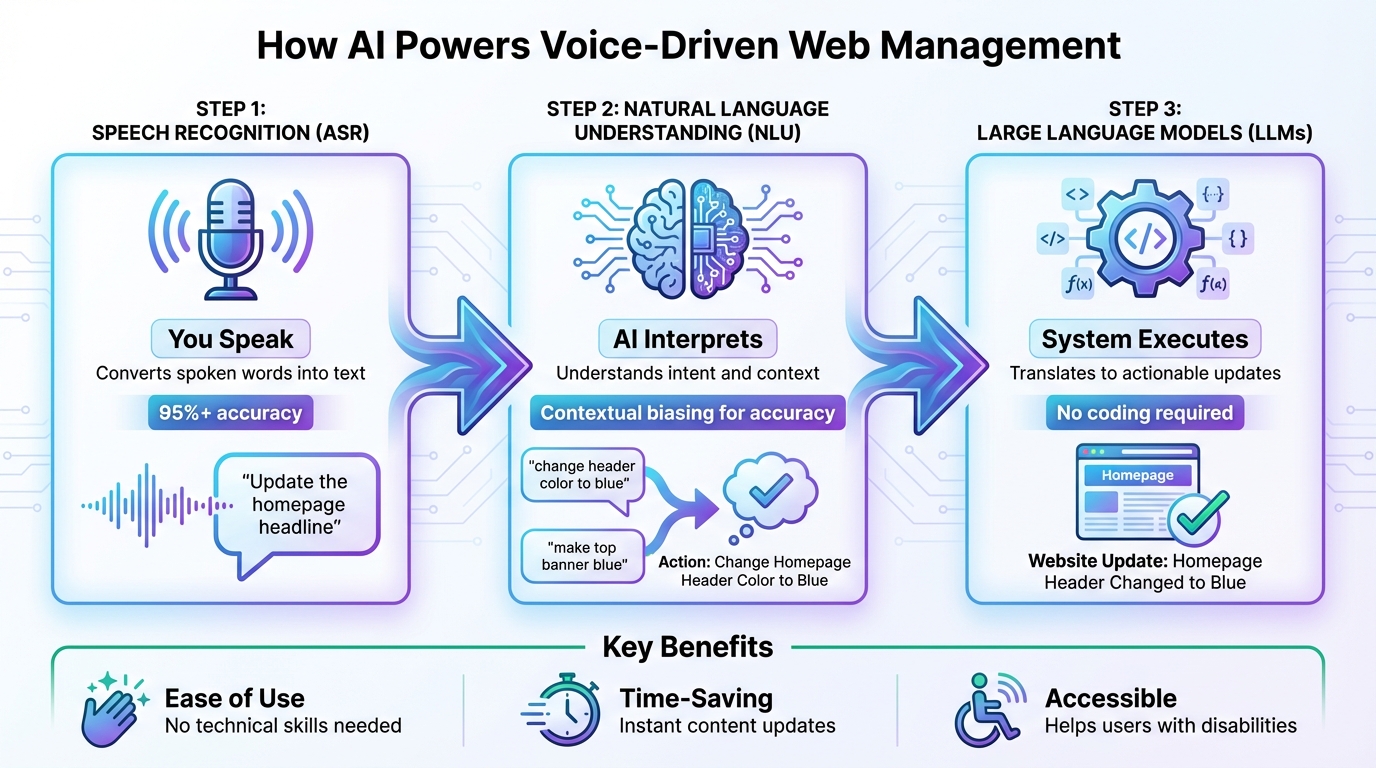
- Speech Recognition (ASR): Converts your spoken words into text with high accuracy.
- Natural Language Understanding (NLU): Interprets your intent, even with varied phrasing.
- Large Language Models (LLMs): Translates your commands into actionable website updates.
Key Benefits:
- Ease of Use: No technical skills required; just speak your changes.
- Time-Saving: Quickly update content, design, and metadata.
- Accessibility: Helps users with disabilities manage websites more easily.
Limitations:
- Speech Accuracy Issues: Background noise or accents can cause errors.
- Privacy Concerns: Voice data collection requires secure handling.
- Complex Tasks: Major design changes may still need traditional methods.
Voice-driven tools like Kintsu.ai simplify website management, making updates as easy as having a conversation. With advancements like WordPress 6.9’s Abilities API, this technology is becoming more accessible and practical for everyday use.
How AI Voice Commands Transform Into Website Updates: 3-Step Process
AI Website Builder with Built-In Voice Agent? Mind Blown
AI Technologies Behind Voice-Driven Web Management
Voice-driven web management uses advanced AI technologies to transform spoken commands into seamless website updates.
Speech Recognition and Natural Language Understanding
At the core of voice-driven web management is Automatic Speech Recognition (ASR) - essentially the system's "ears." ASR converts spoken words into text with impressive accuracy, often exceeding 95% for clear audio, even when dealing with background noise, accents, or varying speech speeds.
Once your speech is transcribed, Natural Language Understanding (NLU) steps in to interpret meaning and intent. This goes beyond simply matching keywords. For example, whether you say "change the header color to blue" or "make the top banner blue", the system understands that both commands aim for the same result.
To handle tricky terms, AI systems use contextual biasing. For instance, during trials with the Web Speech API, words like "azure" were misheard as "as you", and "khaki" was interpreted as "car key." By applying contextual biasing, the system improves its ability to recognize such challenging terms accurately.
These combined processes - transcription and meaning extraction - serve as the foundation for intelligent task execution.
Large Language Models and Action Orchestration
Large Language Models (LLMs) take the transcribed text and determine what actions are needed, even accounting for minor transcription errors. These models then translate your natural language commands into precise, actionable steps. For example, saying "add a blog post on holiday sales" prompts the system to create the post, assign a title, add content, and either publish it or save it as a draft. This eliminates the need for coding knowledge, making website management accessible to everyone.
These technologies also adapt to regional preferences, ensuring a smooth and intuitive experience.
US Format Support
For users in the United States, AI-powered voice systems automatically adjust to U.S.-specific formats. When you mention dates, the system recognizes formats like "December 18, 2025" or "12/18/2025", with the month listed first. Currency references are understood in dollars, using the "$" symbol, and numbers follow the U.S. convention of commas as thousand separators (e.g., "1,000"). Temperature commands default to Fahrenheit, so saying "set the thermostat widget to 72 degrees" is immediately understood. Similarly, measurements use imperial units such as feet, inches, pounds, and miles. This localization ensures that interacting with your voice-driven system feels as natural as everyday conversation.
Common Uses for Voice-Driven Web Management
Voice-driven web management transforms spoken commands into instant website updates, making it easier for anyone - regardless of technical know-how - to manage a website. Let’s dive into how voice commands enhance content creation, design tweaks, and media management.
Content Creation and Editing
Creating and editing content becomes much simpler with voice commands. You can dictate entire blog posts, product descriptions, or website copy with ease. AI tools assist throughout the process, from brainstorming ideas to publishing polished content, significantly reducing production time.
For instance, some AI tools can generate complete WooCommerce product descriptions from just a title and brief instructions. Others go further, delivering tailored content with keyword suggestions, meta descriptions, and even featured images - all based on your input.
Another advantage is consistency. AI ensures your content maintains a unified tone and style across all formats, whether it’s a blog post or a product page. You can also fine-tune existing content with simple commands like “Make this paragraph shorter” or “Add a call-to-action at the end.”
Design and Layout Changes
Voice commands aren’t limited to text - they extend to your site’s design. You can make adjustments to typography, layouts, and styling without needing design skills or coding knowledge.
Some AI-powered website builders now include voice control for design updates. For example, you can say, “Change the fonts” or “Set the heading font to bold and modern” to update typography sitewide. If you need more specific changes, commands like “Make all headings bold on the portfolio page” or “Change all button text to uppercase” target particular sections.
This functionality also covers spacing, colors, and element positioning. Whether you’re refining a landing page layout or tweaking navigation menus, voice commands make it easy to translate your design ideas into technical updates.
Media and Metadata Management
Managing media and metadata is another area where voice commands shine. These systems handle tasks like creating images, optimizing them for search engines, and improving accessibility.
AI tools can automatically generate descriptive alt text for images, making them more accessible. They can also create image variations, remove or replace backgrounds, and enhance text elements within visuals.
Voice commands simplify organizational tasks, too. You can update categories, add tags, or modify metadata across multiple pieces of content in one go. This is especially helpful for websites with large product catalogs or extensive archives. For example, the Abilities API, launching in WordPress 6.9 in December 2025, provides a framework for AI systems to “read, write, and manipulate structured context,” enabling advanced metadata updates through voice instructions.
These examples demonstrate how voice-driven web management leverages AI to turn natural language into actionable changes, streamlining website management like never before.
sbb-itb-42d7c06
Benefits and Limitations of Voice-Driven Web Management
Main Benefits
Voice commands make managing websites easier by allowing users to interact using natural language. This is especially helpful for multitaskers or those who prefer hands-free control.
One standout advantage is efficiency. AI-powered voice tools can handle repetitive tasks like creating content, optimizing SEO, and developing plugins - tasks that might take hours manually but are completed in minutes with voice commands. These tools also reduce the need for specialized technical help. For example, you can generate product descriptions, adjust layouts, or fine-tune metadata without hiring a developer. As James LePage, Director of Engineering and AI at Automattic, explains:
"AI should belong to everyone who builds the web".
Another big plus is accessibility. You don’t need coding or design expertise to make changes - just describe what you need in plain English. Voice AI also ensures consistency across your content, maintaining a uniform tone and style whether you're writing blog posts or updating product pages. Additionally, it simplifies internationalization by generating and translating content into multiple languages with ease.
With these strengths in mind, it’s also important to address the system's current challenges.
Current Limitations
Voice-driven systems aren’t without flaws. One key issue is speech recognition accuracy. Variability in accents, speech patterns, or background noise can lead to misinterpreted commands, causing errors or frustration. Acoustic interference and channel distortion can further affect performance.
Even if a system transcribes speech correctly, it might misunderstand the intent or context of a command. This can lead to irrelevant or incorrect updates, making human oversight critical before publishing changes.
Privacy concerns also come into play. Voice data collection raises security questions, highlighting the need for robust encryption and regular updates to protect user information. Additionally, many systems rely on server-based processing, meaning they won’t work offline unless on-device processing is enabled and the necessary language packs are installed.
When Voice Management Works Best
Despite these challenges, voice management shines in specific scenarios. It’s particularly effective for frequent, minor updates - like tweaking button text, adjusting product prices, or updating headlines across multiple pages. These quick tasks fit well with voice-driven workflows.
Voice commands are also ideal for content-heavy tasks. Whether you’re generating blog posts, crafting product descriptions, or scaling meta descriptions, voice tools can handle large volumes of work efficiently. For users managing extensive product catalogs or content archives, voice commands can update categories, tags, and metadata across hundreds of items in one go.
That said, traditional methods may still be better for more complex tasks, like major design overhauls, custom functionality, or anything requiring detailed manual input. Plus, not everyone uses or prefers voice interaction, so it’s crucial to maintain traditional navigation options for those users.
Getting Started with AI-Powered Voice Management
What You Need to Get Started
To get started, make sure your WordPress site is running version 6.9 or later, and that it supports the Abilities API. You’ll also need a microphone-enabled device and secure authentication for your site. The Abilities API, integrated into WordPress in December 2025, offers a secure and standardized way for AI tools to interact with your site. Once everything is set up, Kintsu.ai makes it simple to turn spoken commands into live updates on your website.
How Kintsu.ai Enables Voice-Driven Updates
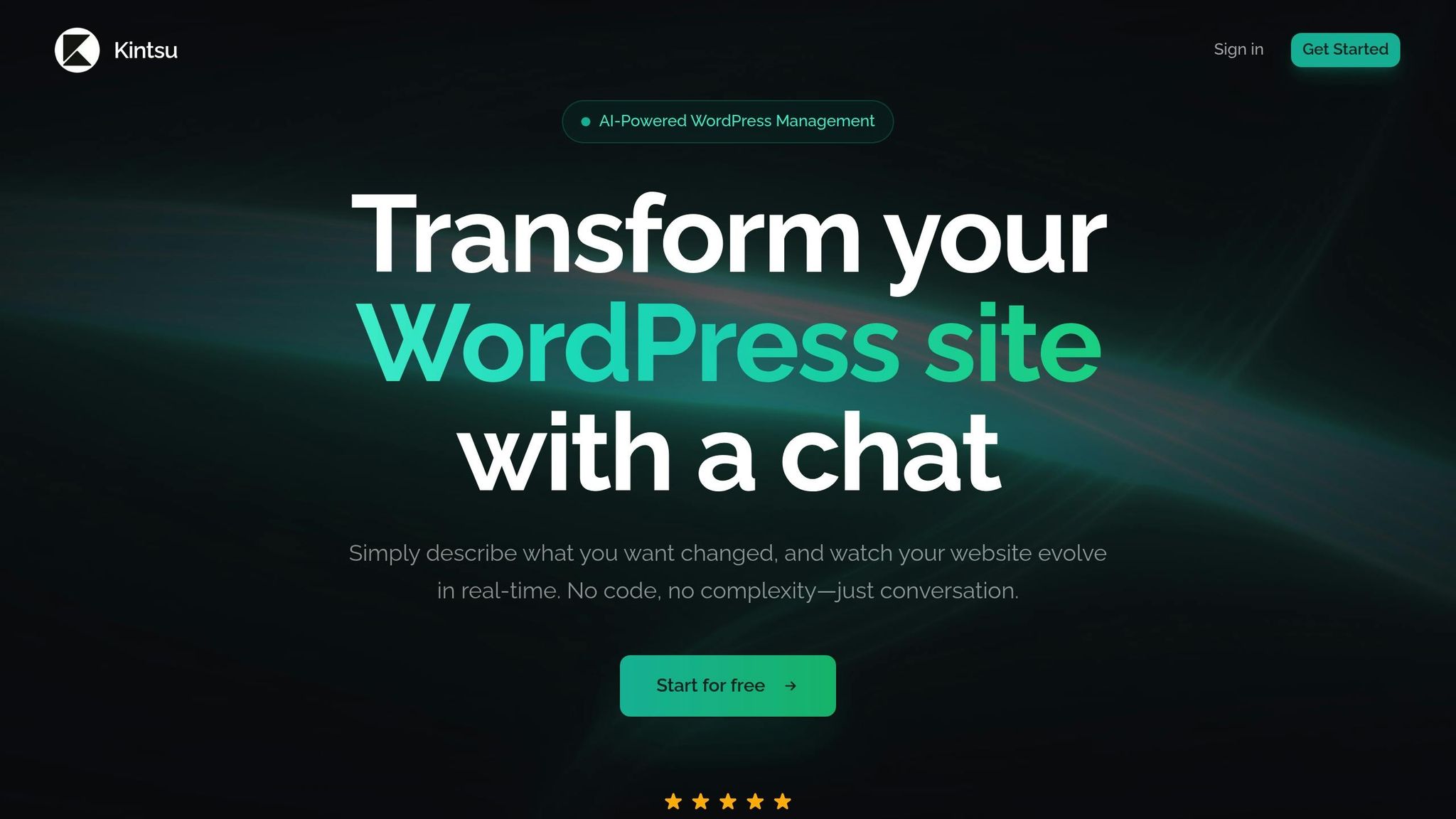
Kintsu.ai connects directly to your WordPress site through a conversational interface, allowing you to make real-time updates without needing to write a single line of code. After linking your site and granting the necessary permissions, all you have to do is speak your desired change. For example, you could say, "Change the homepage headline to Welcome to Our New Store," and the AI will handle the update instantly.
Example Workflows for Daily Tasks
Here are a few ways Kintsu.ai can streamline your daily website management:
- Routine updates: Say something like, "Update the contact page phone number to (555) 123-4567 and add a banner announcing the December sale," and the changes will be applied in seconds.
- Design tweaks: Need a quick design adjustment? Use commands like, "Make the call-to-action button on the pricing page green," or "Increase the font size of all product titles by 2 pixels."
These common tasks, which might normally take time to execute manually, can now be completed almost instantly with simple voice commands.
The Future of Voice-Driven Web Management
Voice-driven web management is quickly becoming a game-changer in how websites are managed. With advancements in AI - particularly in voice technologies that can interpret context, tone, and even emotions - these systems are set to provide responses that feel more natural and intuitive over time. This builds on the current capabilities of AI, which already simplify many aspects of website management.
A major milestone on the horizon is the WordPress Abilities API, set to launch in December 2025. This framework will standardize secure interactions between AI tools and website functionalities. For example, platforms like Kintsu.ai will use this infrastructure to seamlessly convert spoken commands into actual website updates.
These advancements aim to remove the technical hurdles of managing a website. Instead of spending hours learning coding skills or hiring a developer for minor changes, you’ll soon be able to make updates just by speaking. Voice AI is becoming a crucial tool for websites, improving user interaction, accessibility, and even customer service. Kintsu.ai is one of the many tools leading this shift.
New standards will also make websites more accessible, benefiting millions of people with disabilities. Voice commands will simplify everyday tasks and ensure websites run smoothly, aligning perfectly with the rising importance of voice search optimization in search engines.
As these technologies continue to evolve, it’s clear that voice-driven management is poised to become the new standard for website management.
FAQs
How does AI protect voice data privacy in web management tools?
AI-powered voice management tools are designed with privacy in mind, incorporating several measures to protect your data. Many platforms rely on on-device processing for tasks like wake-word detection and converting speech to text. This means your raw audio stays on your device unless you actively choose to send a request. If data does need to be transmitted to the cloud, it’s encrypted and often anonymized, with retention kept to a minimum to reduce potential risks.
To meet privacy regulations such as GDPR and various U.S. state laws, these tools typically offer transparent policies, require user consent, and allow you to opt out or revoke permissions whenever you choose. They also often provide features to delete stored data or disable voice functionalities, giving you control over how your information is handled.
Take Kintsu.ai, for example. Their tools process your voice commands by transcribing them, executing the requested action (like updating a page), and then immediately discarding the transcription. This approach ensures no raw voice data is stored, adhering to strict standards for data security and privacy.
What challenges come with using voice-driven web management?
Voice-driven web management opens up exciting opportunities, but it also brings along some notable challenges. For starters, websites need to be technically equipped to handle voice commands. This often means integrating compatible APIs and making substantial updates to existing systems. On top of that, security and privacy become major priorities - voice data must be encrypted and managed in line with strict regulations to protect users.
Another hurdle is ensuring accurate speech-to-text processing. Background noise, diverse accents, or unclear commands can easily lead to errors or unintended actions, complicating the user experience. From an operational standpoint, performance and scalability are critical. Voice agents depend heavily on API calls and require significant processing power. Troubleshooting can also be tougher, as spoken interactions don’t leave the same clear trail as typed inputs.
Finally, creating a command system that feels intuitive yet powerful enough for all users - whether beginners or pros - demands thoughtful design. Tackling these challenges head-on is essential for delivering a voice-driven web management system that’s both dependable and easy to use.
How does voice-driven web management assist users with disabilities?
Voice-driven web management offers a hands-free solution for users with disabilities to manage and update their websites effortlessly. With simple spoken commands, users can handle tasks like editing pages, publishing posts, or adjusting settings without needing a mouse or keyboard. This approach not only reduces physical effort but also makes routine tasks quicker and more manageable, especially for individuals with limited mobility.
For users who are visually impaired, the system removes the need for intricate keyboard shortcuts by responding to natural language commands. For instance, saying something like, "Add a 'Contact Us' button" or "Change the homepage image" prompts the AI to take care of the technical steps. Similarly, the conversational interface makes web management more approachable for individuals with cognitive disabilities, simplifying complex processes into easy, single-step actions.
Kintsu.ai takes accessibility a step further by enabling users to describe updates in plain English. Commands such as "Increase the font size on the homepage to 18px" or "Add alt text to product images" are instantly processed into live changes. This empowers users to independently maintain their websites while meeting U.S. accessibility standards.