How AI Powers Dynamic Content Updates
How AI enables real-time, personalized website updates with natural language — automating SEO, layout, and bulk changes to scale content management.
How AI Powers Dynamic Content Updates
AI is transforming how websites are managed, making updates faster, easier, and smarter. Managing a WordPress site, once a tedious task, is now simplified with AI tools like Kintsu.ai. Here's what you need to know:
- AI tools automate tasks like updating SEO metadata or changing site tone, which traditionally took weeks, into a few minutes.
- They enable real-time, personalized updates based on user behavior, improving engagement by up to 74% and conversions by as much as 170%.
- Tools like Kintsu.ai let you make changes using plain English commands, eliminating the need for technical expertise.
- AI ensures consistency, reduces errors, and scales effortlessly, whether you're managing 5 or 500 pages.
How to Automate Website Content Updates using AI Agent
sbb-itb-42d7c06
What Are Dynamic Content Updates?
Dynamic content updates are real-time changes made to a website, generated by the server in response to specific user actions, preferences, or triggers. Unlike static websites - where every page is pre-written and identical for all visitors - dynamic websites adjust their content for each user. This means the page you see is tailored to your behavior, much like how your social media feed is personalized compared to someone else’s. Static sites require manual updates for even minor changes, while dynamic sites pull data and create pages uniquely for each visitor.
Why does this matter? Personalization drives results. Research shows that 80% of consumers are more inclined to buy from brands offering personalized experiences. Websites using dynamic content can boost their conversion rates by up to 45%. Platforms like WordPress, which powers over 43% of the web, are key players in delivering dynamic content. This approach not only customizes user experiences but also sets the stage for AI-driven enhancements.
How AI Enables Dynamic Content Updates
AI takes dynamic content to the next level by enabling real-time updates based on user-friendly commands. For instance, you could type something like “make the tone more casual” or “update all SEO descriptions,” and AI would instantly apply those changes across your site.
But AI doesn’t stop at executing commands. It also predicts user needs in real time. As Magnet explains:
Predictive UX goes beyond simple targeted recommendations... It reads visible behaviors and subtle signals, such as a cursor hovering in doubt or a page abandoned too soon.
This means that if a user hesitates on a product page, the system might display a sizing guide. Or, it could simplify the interface if it detects a beginner user, while offering advanced options for experienced visitors.
AI also enables modular content creation. Think of it as a digital "master builder" that assembles content blocks on the fly to create personalized layouts for each visitor. A headless CMS plays a critical role here, delivering tailored content - like industry-specific case studies - via APIs in milliseconds. With over 70% of consumers now expecting personalized interactions, failing to meet these expectations can lead to frustration.
Examples of Dynamic Content Updates
Dynamic updates can range from minor text tweaks to complete overhauls of a page’s layout. For example:
- Text Adjustments: Headlines, product descriptions, and calls-to-action can change instantly based on user behavior or A/B testing.
- Design and Layout Changes: AI can rearrange page sections, update color schemes, modify button shapes, or adjust fonts to match accessibility needs or user preferences.
In e-commerce, dynamic updates allow for personalized product recommendations, location-based pricing, and checkout flows that adapt based on cart value. For content sites, layouts can shift to highlight related articles or resize images depending on the user’s device or behavior.
The impact? Personalized experiences can increase user engagement by up to 74% and improve conversions by as much as 170%. These updates happen automatically, allowing your website to adapt intelligently to each visitor’s unique needs - without requiring constant manual input.
How Kintsu.ai Powers Dynamic Website Updates
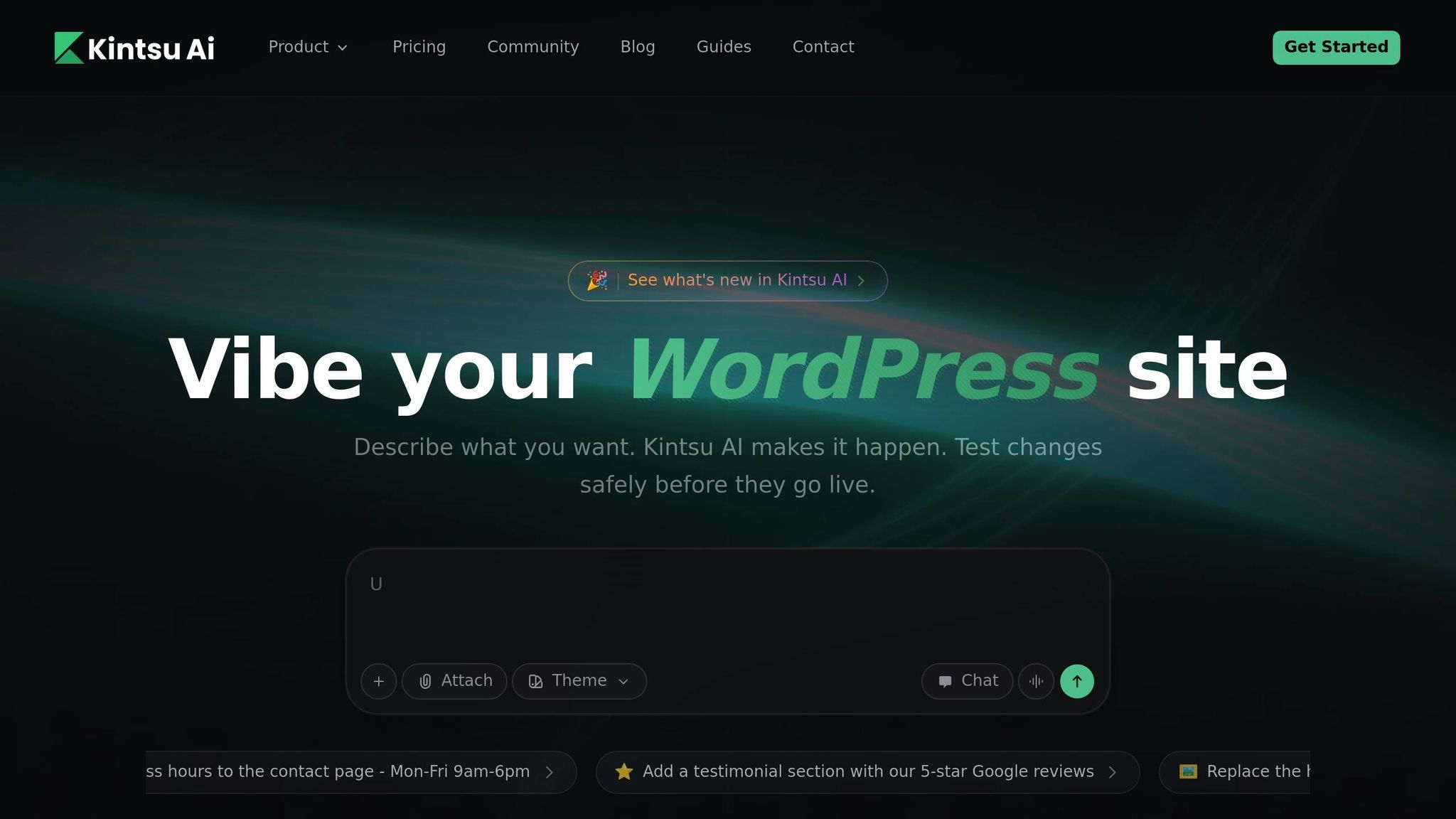
Kintsu.ai changes the way you manage your WordPress site by acting as a conversational tool. Instead of navigating clunky menus or waiting on developers, you simply describe what you need in plain English. The platform takes care of the technical work behind the scenes, integrating easily with WordPress, WooCommerce, Elementor, and even custom themes.
Using Natural Language Processing, Kintsu.ai turns your plain-English instructions into precise WordPress actions. It's already trusted by more than 500 WordPress creators.
A standout feature is the Operational Safety Layer, which protects your site from accidental errors. As the Kintsu team puts it:
It acts as a buffer between you and the code, handling the technical implementation so you don't risk breaking the site.
This layer is especially useful for managing complex plugins or older, more fragile websites.
Connecting Your WordPress Site to Kintsu.ai
Getting started is simple. Head to the Kintsu.ai website, enter your WordPress site’s URL, and sign up for an account. From there, follow the easy setup steps to link your site with the AI assistant. The tool works directly on your live site, so there’s no need for additional software.
Kintsu.ai operates on a freemium model, giving you 10 AI edit credits per month for one WordPress site at no cost. This allows you to try out its conversational editing features before committing. If you need more, Pro plans start at $24/month - far less than the cost of hiring an agency or freelancer for an hour.
Once connected, making changes to your site becomes effortless with natural language commands.
Making Changes with Natural Language
After connecting Kintsu.ai, you’ll interact with your website through a chat interface instead of the usual dashboards. Whether it’s text edits, button updates, new pages, scheduled posts, or even translations, Kintsu.ai handles it all. For example, you could type commands like, “Rewrite the About section to sound friendlier,” or “Optimize this post for SEO,” and the platform will take care of it.
The tool also provides real-time feedback to ensure changes match your brand’s tone and requirements. Higher-tier plans, like Pro and above, come with added benefits such as edit history, rollbacks, and SEO-focused content updates, giving you even more control.
Once the changes are processed, you can review them before finalizing.
Previewing and Applying Changes
Kintsu.ai previews all AI-generated changes, which is key for spotting any formatting issues or tone inconsistencies. If you’re happy with the preview, you can apply the updates with just one click.
Need to make adjustments? The edit history and rollback feature (available with Pro and higher plans) lets you easily undo changes. For those on Business or Enterprise tiers, additional tools like approval workflows and audit logs ensure that updates are reviewed and approved by multiple stakeholders before going live. This blend of speed and precision makes managing your site straightforward and stress-free.
Benefits of AI-Powered Content Updates
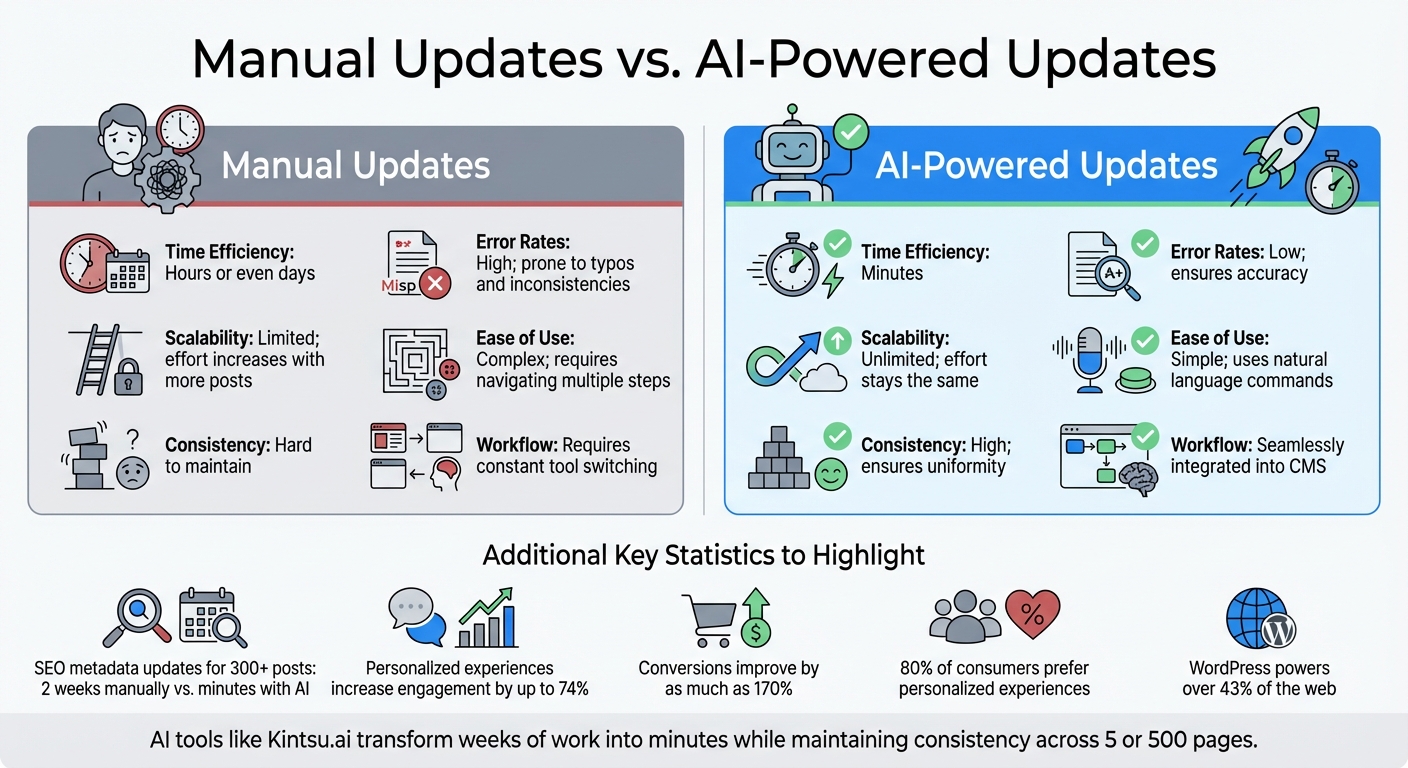
Manual vs AI-Powered WordPress Content Updates Comparison
AI-powered tools take the hassle out of repetitive, time-consuming tasks. Think about it: instead of manually opening, editing, saving, and closing hundreds of posts, AI can complete bulk updates in just minutes. For instance, updating SEO metadata for over 300 posts might take a team nearly two weeks, but AI tools can handle it in a fraction of the time. This not only saves time but also keeps your workflow running smoothly without interruptions.
Another game-changer is how AI simplifies tool management. Traditional workflows often involve bouncing between multiple tools, which increases mental fatigue and the likelihood of errors. By integrating AI directly into your WordPress dashboard, everything stays centralized, reducing mistakes and streamlining the process.
AI also brings real-time personalization to the table. It dynamically tailors content based on user intent, so your site can adjust instantly without you needing to intervene.
For agencies, the benefits are even greater. With centralized control, tools like MCP let you update content across multiple sites using a single natural language command. Sandeep Kumar Mishra from WePlugins summed it up perfectly after using AI for bulk updates:
I should not do this manually ever in the future.
Manual Updates vs. AI-Powered Updates
The contrast between manual and AI-driven updates becomes obvious when you break it down:
| Feature | Manual Updates | AI-Powered Updates |
|---|---|---|
| Time Efficiency | Hours or even days | Minutes |
| Error Rates | High; prone to typos and inconsistencies | Low; ensures accuracy |
| Scalability | Limited; effort increases with more posts | Unlimited; effort stays the same |
| Ease of Use | Complex; requires navigating multiple steps | Simple; uses natural language commands |
| Consistency | Hard to maintain | High; ensures uniformity |
| Workflow | Requires constant tool switching | Seamlessly integrated into CMS |
AI doesn’t just save time - it scales effortlessly. Whether you’re managing five posts or five hundred, the effort remains consistent. Meanwhile, manual updates become exponentially more challenging as the workload grows, making large-scale updates nearly impossible without a dedicated team. With these advantages, WordPress users can easily expand their websites without getting bogged down by tedious tasks.
Conclusion
AI is reshaping the way websites are managed, breaking down technical barriers and making updates simpler than ever. Tools like Kintsu.ai let you refresh your site effortlessly - just describe the changes you want in plain English, and they happen instantly.
This shift from manual to AI-driven updates isn't just about ease of use - it’s about broadening access and scaling efficiently. With Natural Language Processing, your conversational commands are translated into precise WordPress actions. Whether it’s building new pages, tweaking designs, or fine-tuning content, the heavy lifting happens behind the scenes. This means you can stay focused on your goals while the technology handles the complexity. By minimizing errors and streamlining processes, AI lets you spend more time on growth and strategy.
For businesses juggling multiple sites or frequent updates, AI tools like these offer a game-changing solution. They ensure consistency, reduce mistakes, and free up your team to tackle higher-value tasks. Kintsu.ai’s conversational interface and built-in safety measures make managing websites a smooth, intuitive process. It’s a step toward a future where smarter tools make website management as simple as having a conversation.
FAQs
How does AI help create dynamic content updates?
AI brings a new level of flexibility to website management by enabling dynamic content updates based on user instructions and behavior analysis. Thanks to advanced natural language processing (NLP), it can understand user input - whether it's highly specific or more general - and turn those requests into actionable website changes. This might include updating text, tweaking layouts, or altering design elements, all without requiring any coding knowledge.
Beyond just following commands, AI takes things further by analyzing visitor behavior and site interactions. This analysis helps pinpoint areas for improvement, allowing it to suggest updates that enhance the user experience and keep content fresh. By blending natural language comprehension with behavioral insights, AI simplifies website management and ensures that updates are not only easy to implement but also aligned with user needs.
What are the advantages of using AI tools like Kintsu.ai to manage your website?
AI tools such as Kintsu.ai are transforming website management by making it quicker, simpler, and more user-friendly. Thanks to its conversational interface, you can describe the changes you need - whether it's updating text, tweaking layouts, or altering styles - and see those changes applied instantly. The best part? You don’t need any coding knowledge to make it happen. This not only saves time but also removes the technical hurdles that often come with website updates.
Beyond ease of use, Kintsu.ai incorporates intelligent features to ensure your updates are accurate and fit seamlessly within the context of your site. Plus, built-in safeguards help catch potential errors, preventing issues that could harm your site's performance. These capabilities streamline the entire process, allowing users - regardless of their technical skill level - to update and manage their websites with confidence.
How does AI help improve my website's engagement and conversion rates?
AI helps websites become more engaging and effective by creating personalized and dynamic content experiences. It works by analyzing user behavior and preferences, allowing your site to adapt its content, design, and interactions to better connect with visitors. This approach encourages users to spend more time on your site and take meaningful actions, like signing up for a newsletter or completing a purchase.
What’s more, AI-powered tools make it easy to implement real-time updates without needing any coding knowledge. These tools can automatically test and fine-tune elements like layout, copy, and calls-to-action, ensuring your website consistently performs at its best. By constantly adjusting to meet user expectations, AI helps deliver more relevant experiences, ultimately driving higher engagement and conversions.