Improving SEO with AI Readability Tools
Use AI readability tools to simplify language, improve structure, and increase SEO visibility, engagement, and AI citations.
Improving SEO with AI Readability Tools
Your content’s readability directly affects SEO performance. Poor readability leads to high bounce rates and low engagement, signaling to search engines that your page isn’t valuable. With AI readability tools, you can improve clarity, simplify language, and optimize structure for both users and AI-driven systems like Google’s AI Overviews. Here’s why it matters and how it works:
- Better Engagement: Shorter sentences, clear headings, and simpler language keep readers on your page longer.
- SEO Boost: Readable content aligns with search algorithms, increasing visibility and chances of AI citations.
- AI Optimization: Tools like Flesch-Kincaid scores ensure your content is easy for both humans and AI to process.
- Higher Traffic: 57% of SEO professionals saw traffic growth after using AI tools to refine content.
AI readability tools help you create content that ranks higher, engages users, and gets noticed by AI systems. Focus on clarity, structure, and keyword placement to stay competitive in today’s search landscape.
Improve Your SEO Content With This Epic Readability Tool
sbb-itb-42d7c06
SEO Problems That AI Readability Tools Fix
When content is tough to read, it creates a ripple effect of SEO challenges. Visitors faced with dense paragraphs or overly complex sentences tend to leave quickly - 73% of users abandon a webpage within 10 seconds if readability is poor. This behavior signals search engines that your content isn’t meeting user needs, which can harm your rankings over time.
But it’s not just about human readers anymore. Modern search algorithms like Google’s BERT and MUM prioritize content that AI systems can easily process and extract information from. If your text is unclear to these systems, your visibility in AI-driven search results takes a hit. Irina Shvaya, Founder & Marketing Consultant at eSEOspace, sums it up well:
Machine-understandability is the new prerequisite for human discovery. If an LLM cannot accurately parse, segment, and synthesize your content, it will not be selected as a source for a generative answer.
AI readability tools tackle these problems by analyzing your content in real time. They highlight issues that affect both user experience and search visibility, helping you refine your content for better performance.
Combining Readability with Keyword Use
Striking the right balance between clear language and effective keyword use is a classic SEO challenge. Overloading your content with keywords can make it sound robotic, while underusing them can leave search engines unclear about your topic.
AI readability tools simplify this process. They suggest semantic keywords and entity-based optimization that naturally fit your content’s context. Instead of awkwardly forcing exact-match keywords, these tools recommend related terms and concepts that align with your message. They also evaluate your document structure - like headings, paragraph flow, and logical organization - to ensure keywords appear where they make the most sense.
These tools go further by addressing structural issues that can confuse readers and AI systems alike. They flag passive voice and suggest active alternatives, pinpoint vague pronouns like "it" or "they", and recommend replacing them with specific nouns for clarity. Defining acronyms and key terms on first use also strengthens your content’s authority and makes it easier for readers and AI to follow.
The results speak for themselves. 57% of WordPress SEO professionals reported an increase in organic traffic after using AI tools for SEO. Shifting from keyword density to semantic relevance allows your content to rank well while staying helpful and engaging for readers.
Increasing User Engagement and Time on Page
Poor readability doesn’t just push visitors away - it stops them from fully engaging with your content. Long, winding sentences reduce comprehension, and AI readability tools are quick to identify these issues. They suggest breaking complex sentences into shorter, clearer ones for better understanding.
Dense blocks of text are another common problem, especially on mobile devices. These tools recommend breaking up text with bullet points, subheadings, and white space to improve scannability. They also enforce shorter paragraphs - usually 2 to 3 sentences - to make content easier to digest and keep readers scrolling. Additionally, they flag technical jargon or overly complex vocabulary, offering simpler alternatives that broaden your audience without oversimplifying.
Engagement metrics improve when readability is prioritized. Aiming for a Flesch Reading Ease score of 60 to 70 ensures your content is accessible to a general audience. This readability level encourages visitors to stay on your page longer, reduces bounce rates, and signals to search engines that your content delivers value. As John Mueller, Search Advocate at Google, explains:
If you write content that's hard to understand, then it's going to be harder for people to stay and read. Lower user engagement can indirectly affect your ranking over time.
AI readability tools also make your content more inclusive. By adjusting complexity levels, you can better serve non-native English speakers and individuals with learning disabilities like dyslexia or ADHD. Clearer sentence structures and smarter keyword placement enhance both human engagement and AI-driven visibility, making your content work harder for you.
What AI Readability Tools Do for SEO
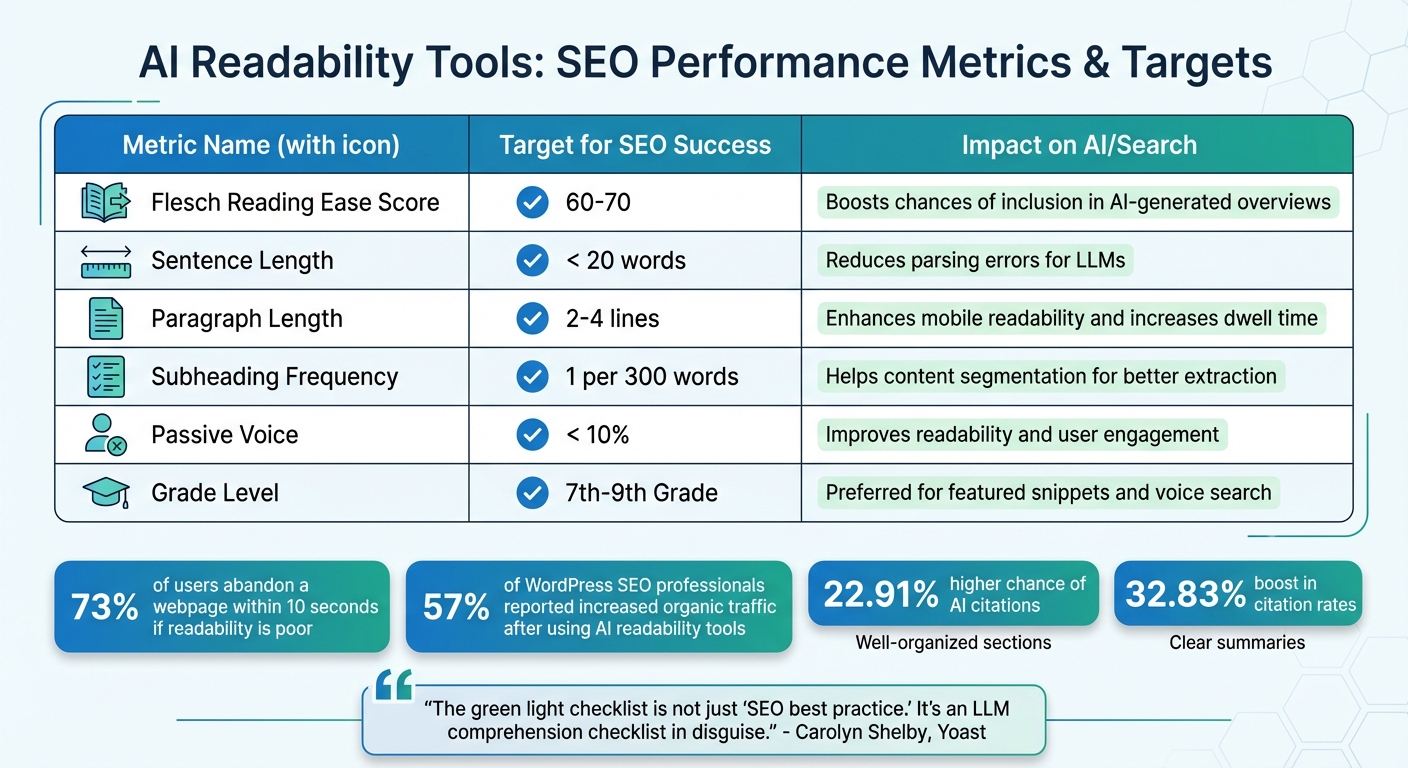
AI Readability Tools SEO Impact: Key Metrics and Performance Benchmarks
AI readability tools act like real-time editors, analyzing your content to improve its clarity and effectiveness. These tools address many SEO challenges by offering targeted feedback on everything from word choice to structure. The goal? To create content that engages readers while also aligning with search engine algorithms. As SEO trends shift toward "retrievability", your content needs to be clear enough for large language models (LLMs) to process and reference in AI-generated responses. Essentially, these tools bridge the gap between user engagement and AI trust by focusing on readability and structure.
Instant Feedback and Readability Scores
One of the standout features of AI readability tools is their ability to provide real-time metrics. They monitor factors like sentence length, paragraph structure, passive voice usage, and reading grade levels - all of which influence whether users stick around or leave your page. For instance, if a sentence runs on for more than 20 words or a paragraph looks too bulky for mobile screens, the tool flags it for revision before you hit publish.
Many of these tools also assign a score or grade to your content. For example, the Flesch Reading Ease score ranges from 0 to 100, with a target of 60 to 70 being ideal for a general audience.
| Readability Metric | Target for SEO Success | Impact on AI/Search |
|---|---|---|
| Flesch Reading Ease | 60–70 | Boosts chances of inclusion in AI-generated overviews |
| Sentence Length | < 20 words | Reduces parsing errors for LLMs |
| Paragraph Length | 2–4 lines | Enhances mobile readability and increases dwell time |
| Subheading Frequency | 1 per 300 words | Helps content segmentation for better extraction |
| Passive Voice | < 10% | Improves readability and user engagement |
| Grade Level | 7th–9th Grade | Preferred for featured snippets and voice search |
As Carolyn Shelby, an SEO and AI expert at Yoast, puts it:
The green light checklist is not just 'SEO best practice.' It's an LLM comprehension checklist in disguise.
Analyzing Meaning and Structure
AI readability tools go beyond just metrics - they also refine your content on a deeper, semantic level. Using natural language processing (NLP), they ensure your terminology aligns with common search patterns, a process often referred to as prompt alignment.
These tools also evaluate your HTML structure, checking for the proper use of H1, H2, and H3 tags, and making sure lists are formatted correctly with UL or OL tags. Additionally, they assess whether your key points are "frontloaded" in introductory sections or TL;DR summaries. This increases the chances of your content being cited in AI-generated answers.
Research from 2025 highlights the importance of structure in AI citations. For example, well-organized sections are linked to a 22.91% higher chance of being cited by AI systems, while clear summaries can boost citation rates by 32.83%.
Some tools even compare your content's structure - such as word count, heading density, and media usage - against top-performing pages in live search results. This benchmarking helps pinpoint gaps in your content and suggests improvements that cater to both traditional SEO and the growing role of AI in determining which sources to display.
Adding AI Readability Tools to WordPress
Integrating AI readability tools into WordPress makes improving content clarity and SEO much simpler. The best part? You don't need to be a tech wizard to get started. These tools seamlessly plug into WordPress, whether you prefer plugin-based solutions or conversational AI platforms. The goal is to choose tools that match your workflow, cutting down on manual tasks without complicating the process. This integration connects content creation with optimization, making it easier to enhance readability while boosting SEO.
AI readability tools for WordPress typically fall into two categories: plugins that add optimization features directly to your editor and conversational platforms that let you request changes in plain language. For instance, some plugins include an "AI Optimize" button to automatically adjust keyword density, sentence structure, and paragraph length. These tools often provide real-time feedback in a sidebar, flagging potential issues before you hit "publish."
If you prefer a more intuitive method, platforms like Kintsu.ai offer features like "Builder Chat." This allows you to describe changes - such as "make this section more polished" - and the AI handles the edits for you. Without touching code, you can reorganize sections, tweak formatting, and refine readability effortlessly.
Making Content Updates Easier with AI
AI tools are transforming WordPress content management by moving from manual edits to conversational adjustments. Instead of fiddling with HTML tags or CSS, you can simply describe what you want, and the AI will take care of the rest. Take Kintsu.ai as an example - it offers over 25 AI-driven features tailored for WordPress, letting you handle layout tweaks and content updates with natural language commands.
These tools also come with safeguards to prevent layout errors or plugin conflicts. You can preview AI-generated changes in a staging environment before they go live, ensuring everything looks right. Plus, audit trails help you track changes and roll back updates if needed.
The benefits are clear in everyday tasks. If your site has missing alt tags, AI can detect and suggest fixes automatically. Struggling with heading hierarchy? The tool analyzes your content and applies corrections without you lifting a finger. As WordPress developer Ben Bond points out:
Custom solutions provide the flexibility to meet unique business requirements while maintaining the integrity of your WordPress site.
Saving Time for Agencies and Freelancers
For agencies and freelancers juggling multiple WordPress sites, AI readability tools are a game-changer. A whopping 71% of users report saving time as the biggest advantage of using AI tools in their workflow. Tasks like generating outlines, fixing readability issues, and optimizing SEO can now be done in seconds, which directly boosts project capacity and helps meet client deadlines.
The automation of repetitive tasks is where the real time savings happen. Instead of manually checking every post for sentence length, passive voice, or structure, AI tools handle these checks in real time as you write. Tools like Kintsu.ai even streamline collaboration by enabling approval workflows. Marketing teams, product managers, and stakeholders can review changes before they go live, making feedback loops more efficient.
Freelancers, too, benefit from reduced technical hurdles. There's no need to mess with complex API setups or learn coding - optimizing content becomes straightforward. Onboarding new team members is quicker, too, as they can dive into content optimization without needing deep technical training. As Ben Bond wisely notes:
AI is a powerful tool in your content arsenal, but it should complement, not replace, human oversight and creativity.
Tracking Results from AI Readability Tools
Once you've optimized your content, the next step is to measure its impact. But don’t just focus on traditional rankings - expand your tracking to include AI citations, engagement signals, and organic traffic trends. These metrics offer a clearer picture of how your efforts are paying off. For instance, AI citations from platforms like ChatGPT, Perplexity, and Google AI Overviews now play a key role in SEO, appearing in 13.14% of all U.S. desktop searches as of March 2025.
AI readability tools can also provide Content Scores, which assess your pages based on structural and semantic criteria. These scores often align with AI citations and overall SEO performance. Brands that leverage these tools to prioritize content updates have reported a 45% increase in organic traffic growth compared to those relying on traditional methods. By tracking these metrics, you can connect improvements in readability and engagement with real SEO gains.
Tracking Search Rankings and Traffic
One critical metric to monitor is AI Visibility, which measures how often your site is cited by AI platforms. Data shows that high-clarity content leads to a 32.83% increase in AI citations, while Q&A-style formats correlate with a 25.45% increase. In short, making your content easy to read not only benefits human visitors but also makes it more accessible for AI systems.
To track AI-driven traffic, use tools like Google Analytics 4. Look for new referrers, such as perplexity.ai or copilot.microsoft.com, and monitor spikes in Direct traffic, which can indicate visits from AI tools that don’t pass traditional referrer data. Keep in mind that 92% of citations in Google AI Overviews come from pages already ranking in the top 10 search results. This means improving readability can help push your content into this elite group.
Google Search Console is another valuable tool. Filter for keywords with an average position between 5 and 15 - these are your "quick wins". Enhancing readability on these pages can help them climb to the first page of search results. If a page has over 1,000 monthly impressions but a click-through rate (CTR) below 2%, consider rewriting the meta title and description to make them clearer and more actionable.
Measuring User Behavior Metrics
Search rankings are important, but user behavior metrics can provide deeper insights into how well your content performs. In Google Analytics 4, engagement rate has replaced the traditional bounce rate. A session is now considered "engaged" if a user stays for 10+ seconds, triggers a key event, or views at least two pages. Optimized content often achieves engagement rates above 60%. For blog posts, aim for an average engagement time of over one minute - this is a good indicator of quality.
Another key metric is scroll depth, which shows how far users navigate through your content. AI readability tools help structure your content to keep readers scrolling, signaling to search engines that your page is valuable. To get a clear picture of your progress, compare metrics year-over-year to account for seasonal trends.
Set up a regular reporting schedule to stay on top of your performance. Review organic sessions and Search Console clicks weekly, track keyword position changes bi-weekly, and conduct a full monthly review of CTR, engagement, Core Web Vitals, and conversions. As Cecilia Meis, Senior Editor at Semrush, explains:
Clarity and structure are not SEO shortcuts. They simply make information easier for both people and AI systems to interpret.
Lastly, keep an eye on conversion rates, such as email signups. A healthy blog conversion rate typically falls between 2% and 5% of organic traffic. If your readability improvements are effective, you should see these numbers rise alongside your engagement metrics.
Conclusion
AI readability tools are transforming the way SEO aligns with user engagement. These tools have turned content optimization into a dual-purpose approach, catering to both human readers and AI-driven systems. Research shows that content with high clarity has a +32.83% correlation with AI citations, and incorporating strong E-E-A-T signals boosts this by another +30.64%. These factors play a critical role in determining whether platforms like ChatGPT and Google AI Overviews cite your content - or overlook it entirely.
The impact of these tools is evident in the numbers. For instance, 57% of WordPress SEO professionals reported increased organic traffic after adopting AI readability tools. Additionally, B2B content strategies leveraging these tools have achieved an average ROI of 844% over three years. As Kevin Fincel, Founder of Geol.ai, insightfully explains:
AI has changed content from a 'write → rank → convert' loop into a distributed retrieval problem: your content has to satisfy human intent and be legible, extractable, and trustworthy for AI ranking and answer systems.
The rise of multi-surface discovery - content appearing across traditional search, AI-generated answers, and enterprise knowledge systems - means your content must meet new standards. Without clear definitions, scannable headers, and straightforward sentence structures, your content risks being ignored. And with AI bots prioritizing recent material, frequent updates are no longer optional.
Adopting AI readability tools isn't just about following trends. It's about adapting to a landscape where AI systems increasingly dictate what content gets noticed. By creating clearer, more structured content now, you're ensuring your pages stay competitive in an ever-evolving digital ecosystem.
FAQs
What readability score should I aim for?
To make your content accessible to a wide audience, aim for a Flesch Reading Ease score between 60 and 70. This range ensures that most readers can easily understand your writing. When your content is simple and clear, it becomes more engaging, which can also give your SEO efforts a boost.
Can AI tools improve rankings without keyword stuffing?
Yes, AI tools can help improve rankings without resorting to keyword stuffing. These tools suggest relevant keywords naturally fitting the content and focus on enhancing readability, ensuring the material is engaging and easy to understand for readers. This approach aligns with modern SEO practices, emphasizing high-quality and user-focused content.
How do I track AI citations and AI-driven traffic?
Tracking AI citations and AI-driven traffic calls for tools designed specifically for this purpose. Standard analytics platforms, such as Google Analytics, aren't equipped to track AI citations directly. Instead, platforms like Siftly and Citedify step in to monitor brand mentions, citation rates, and sentiment across AI platforms.
To improve your visibility in AI-generated responses, pay close attention to key metrics like:
- Citation frequency: How often your content is referenced.
- Sentiment analysis: Whether mentions are positive, neutral, or negative.
- Relevance: How well your content aligns with user queries or AI-generated contexts.
By focusing on these metrics, you can fine-tune your content strategy to stay ahead in the AI-driven landscape.