AI Competitor SEO Tools: What to Look For
Compare Semrush, Ahrefs, Similarweb, SpyFu, and Moz Pro — features, pricing, strengths, and which AI SEO tool fits your goals.
AI Competitor SEO Tools: What to Look For
In 2026, SEO is no longer just about search rankings - it's about how AI assistants like ChatGPT and Gemini interact with your brand. This shift has made AI-powered SEO tools essential for tracking competitor mentions, identifying content gaps, and improving AI citations. The article compares five leading platforms - Semrush, Ahrefs, Similarweb, SpyFu, and Moz Pro - focusing on their ability to provide actionable insights in an AI-driven landscape.
Key Takeaways:
- Semrush: Comprehensive, blends traditional SEO with AI visibility; higher cost and learning curve.
- Ahrefs: Best for backlink analysis and user-friendly; credit-based pricing can add up.
- Similarweb: Market-level insights and AI search tracking; enterprise-focused with high starting costs.
- SpyFu: Budget-friendly with unlimited data; lacks depth in audits.
- Moz Pro: Beginner-friendly with simplified metrics; smaller backlink database.
Quick Comparison
| Tool | Best For | Starting Price (Monthly) | Key Features |
|---|---|---|---|
| Semrush | All-in-one SEO & AI tracking | $117.33 | AI visibility, keyword tools, backlink gap analysis |
| Ahrefs | Backlink analysis & research | $29 | 35T backlinks, AI content tools, traffic value tracking |
| Similarweb | Market-level insights | $125 | AI search intelligence, audience behavior, competitive traffic patterns |
| SpyFu | Budget-friendly PPC & keywords | $39 | Unlimited searches, PPC data, historical keyword trends |
| Moz Pro | Simplified SEO for beginners | $49 | True Competitor tool, keyword gap analysis, link intersect insights |
Each tool serves different needs - choose based on your goals, whether it's detailed analysis, market insights, or affordability.
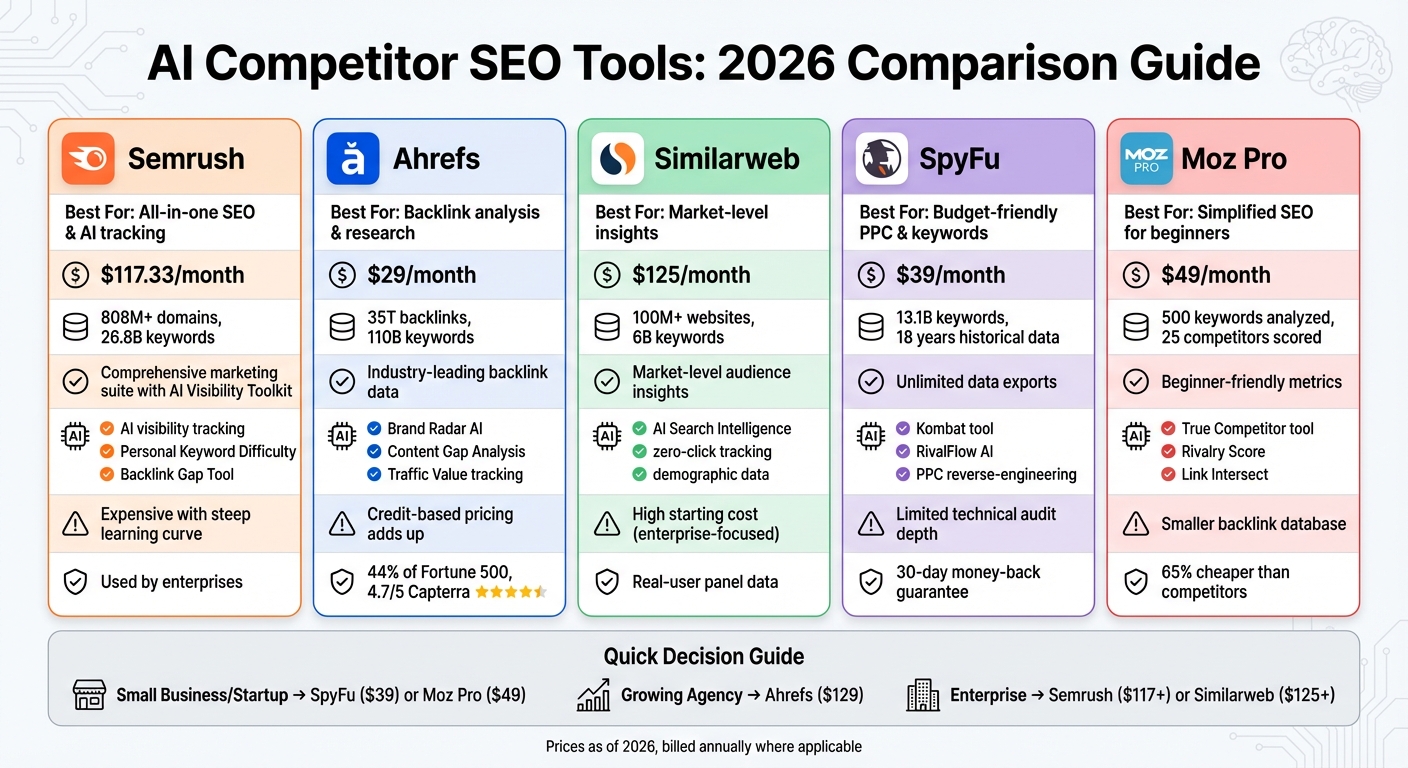
AI SEO Tools Comparison: Features, Pricing, and Best Use Cases
The 8 Best AI SEO Tracking Tools: A Side-by-Side Comparison - Search Influence
1. Semrush

Semrush stands out as a robust platform for competitor analysis, offering data on over 808 million domain profiles across 142 geographic databases. By blending traditional SEO metrics with AI-powered insights, it provides an extensive suite of tools to analyze competitors effectively. Below, we explore how Semrush leverages AI to deliver keyword, backlink, and traffic insights.
Keyword Analysis
Semrush's keyword tools are designed to uncover opportunities and sharpen your content strategy. The Keyword Magic Tool taps into a massive database of 26.8 billion keywords, while the Keyword Gap Tool allows you to compare keyword performance across up to five competitors at once. Using the Organic Research feature, you can analyze competitor keyword portfolios, track ranking shifts, and examine their content strategies.
One standout feature is the Personal Keyword Difficulty (PKD) metric, which uses AI to estimate your likelihood of ranking for a particular keyword based on your site's authority. Additionally, the Keyword Strategy Builder helps organize keywords into well-structured content clusters. Together, these tools provide deep insights into long-tail keyword opportunities and help benchmark your performance against competitors through AI-enhanced analysis.
Backlink Insights
For backlink analysis, Semrush offers the Backlink Gap Tool and Backlink Analytics, which enable you to compare link profiles with up to five competitors, identify referring domains, and create targeted outreach lists. The AI-powered Semrush Copilot takes this a step further by automatically identifying backlink opportunities and offering actionable recommendations for growth.
The Link Building Tool simplifies outreach by managing campaigns, sending personalized emails, and tracking responses - all within the platform. For enterprise users, the Site Audit tool can crawl up to 1,000,000 pages per month on Business plans. These features collectively help you pinpoint high-value backlink opportunities and gain insights into the strategies of your competitors.
Traffic Analytics
Semrush's Traffic & Market Toolkit provides a detailed look at competitor traffic patterns, including visitor trends, top traffic sources, and audience demographics such as age, gender, and location. This data helps you understand whether competitors are driving traffic through organic search, paid ads, or social media, allowing you to refine your own channel strategy.
The Domain Overview tool adds a high-level perspective by providing metrics like Authority Score and traffic cost, helping you benchmark your performance against competitors in key areas. These insights tie directly into strategic decision-making, making Semrush a valuable ally in AI-driven SEO.
Pricing
Semrush offers a flexible subscription model, allowing users to choose individual toolkits or bundled options. Paid plans start at $117.33 per month when billed annually. The Traffic & Market Toolkit is priced at $289 per month, while the AI Visibility Toolkit costs $99 per month. For those seeking a comprehensive solution, the Semrush One bundle combines traditional SEO tools with AI tracking, with pricing available through sales contact depending on the tier (Starter or Pro+). A free account is also available, offering limited access to tools like Semrush Copilot and basic domain overview features.
2. Ahrefs
Ahrefs is an AI-first marketing platform that blends traditional SEO tools with advanced AI features, offering a robust solution for marketers. Its database includes 35 trillion live backlinks and 110 billion keywords across 171 countries, powered by AhrefsBot - the web's second most active crawler. What makes Ahrefs stand out is how seamlessly it integrates AI into competitor analysis, from keyword research to tracking brand performance.
Keyword Analysis
The Keywords Explorer provides data on 28.7 billion keywords, delivering insights like Keyword Difficulty (KD), search volume, and a "Traffic Potential" metric. Its AI-enhanced search intent analysis categorizes queries into informational, commercial, transactional, or navigational purposes. The Content Gap Analysis tool identifies keywords your competitors rank for but you don't, while the Parent Topic feature helps you determine whether a keyword fits into a broader topic. Meanwhile, the Site Explorer lets you reverse-engineer competitors' success by analyzing top-performing pages and tracking Organic Share of Voice (SoV). Notably, 44% of SEO professionals prioritize Ahrefs' Domain Rating (DR) as their key metric. This comprehensive approach to keyword analysis lays the groundwork for detailed backlink and traffic insights.
Backlink Insights
Ahrefs boasts an index of 18.3 billion pages, backed by over a decade of historical data for trend tracking. Its Site Explorer tool offers real-time updates on backlink activity, enabling users to respond swiftly to competitors' link-building efforts. The Best by Links report highlights the most-linked pages of competitors, providing inspiration for content that naturally attracts backlinks. With 77 backlink-related API endpoints, agencies and enterprise users can filter out low-quality links and focus on high-authority opportunities. Research shows that 64% of SEO professionals trust Ahrefs for accurate backlink data.
"Ahrefs is still the gold standard for research. We use it for the 'why' and 'who,' then switch to other tools for the 'how-to-write'."
– Veza Digital
These backlink insights enhance Ahrefs' ability to analyze traffic and competitor strategies.
Traffic Analytics
Ahrefs integrates AI search traffic metrics into its Site Explorer, showing where competitors appear in AI-generated responses. The Brand Radar tool tracks brand visibility across platforms like ChatGPT and other LLM chatbots, using a database of over 100 million prompts. The platform also calculates Traffic Value, estimating the cost of organic traffic if purchased through Google Ads - offering a clear comparison of SEO versus paid campaigns. The Pages Inspect tool monitors competitors' content updates and analyzes how changes impact traffic, delivering real-time insights for content strategy. Additional AI features, like an AI Detector for identifying AI-written content and an AI Content Grader for benchmarking articles against top-ranking pages, further enhance its capabilities.
Pricing
Ahrefs' pricing caters to a range of needs, offering access to both traditional and AI-powered tools.
- Starter plan: $29/month for basic search and competitor analysis
- Lite plan: $129/month, including 5 projects and 6 months of historical data
- Standard plan: $249/month, adding features like Content Explorer and extending historical data to 2 years
- Advanced plan: $449/month, designed for teams with Looker Studio integration and 5 years of historical data
- Enterprise plan: $1,499/month, offering unlimited historical data, API access, and SSO capabilities.
Optional AI add-ons include Brand Radar AI ($199/month) for tracking brand performance on platforms like ChatGPT and Microsoft Copilot, and the Content Kit ($99/month), which includes tools like the AI Content Helper and AI Content Grader. Trusted by 44% of Fortune 500 companies, Ahrefs has earned ratings of 4.7/5 on Capterra, 4.5/5 on G2, and 9.2/10 on TrustRadius.
"We built AI into every corner of Ahrefs to do the heavy lifting, so you can focus on strategy and creativity."
– Ahrefs
3. Similarweb
Similarweb takes a broader approach to competitor analysis, focusing on overall market performance rather than just keyword rankings. The platform monitors over 100 million websites and 6 billion keywords across 190 countries, offering insights into user visits across web platforms, mobile apps, and retail channels. Its proprietary real-user panel helps distinguish between bot traffic and human behavior, providing valuable data on session lengths, demographics, and user loyalty.
Traffic Analytics
Similarweb, like Semrush and Ahrefs, provides market-level insights that go beyond standard keyword metrics. It identifies the channels driving competitor growth, offering a clearer picture of market dynamics. For instance, in January 2026, Limor Barenholtz, Director of SEO & GEO at Similarweb, used the Gen AI Intelligence feature to analyze the cryptocurrency exchange industry. The analysis revealed that Binance had a 16.31% brand visibility score in AI search results. However, competitors outperformed Binance in citations related to "crypto security", highlighting a strategic gap.
"We use Similarweb to better understand the categories our clients operate in, their share of those categories, and how it might have changed over time. That benchmarking can help to diagnose issues with brand health, to inform market sizing, and ultimately help us spot opportunities for clients."
– Duncan Nichols, Director of Strategy and Planning, Croud
The platform's AI Search Intelligence module is particularly valuable in tracking brand visibility within generative AI engines like ChatGPT. This is increasingly important since by 2026, only about 8% of AI-related queries result in website clicks. Additionally, users can monitor competitor career pages for spikes in job listings, which often signal an upcoming expansion into new markets before any public announcements.
By providing a comprehensive view of user behavior and engagement, Similarweb equips businesses with the tools needed to navigate an AI-driven discovery landscape effectively.
Keyword Analysis
The platform’s Keyword Generator includes filters like "Last 28 Days" and "Trending", making it easier to spot emerging terms before competitors do. It also identifies keywords driving traffic to competitors and highlights content gaps that can be addressed. A unique feature is its ability to measure zero-click searches, revealing how often users find answers directly on search results pages or through AI summaries, bypassing clicks to competitor websites.
These keyword insights, combined with its competitive pricing, make Similarweb a strong contender for businesses looking to refine their strategy.
Pricing
Similarweb offers three self-service pricing tiers tailored to different business needs:
- Competitive Intelligence: Starts at $125/month (billed annually) or $199 month-to-month. Includes 3 months of historical data and competitor alerts.
- Competitive Intel & SEO: Priced at $335/month (annually) or $399 month-to-month. Adds keyword research, rank tracking, and backlink analytics.
- Competitive Intel, SEO & Ads: Costs $540/month (annually) or $649 month-to-month. Includes 6 months of historical data and full ad intelligence.
The AI Search Intelligence module is available as an add-on for $99/month. Enterprise plans come with custom pricing, offering unlimited historical data, API access, and dedicated support.
sbb-itb-42d7c06
4. SpyFu
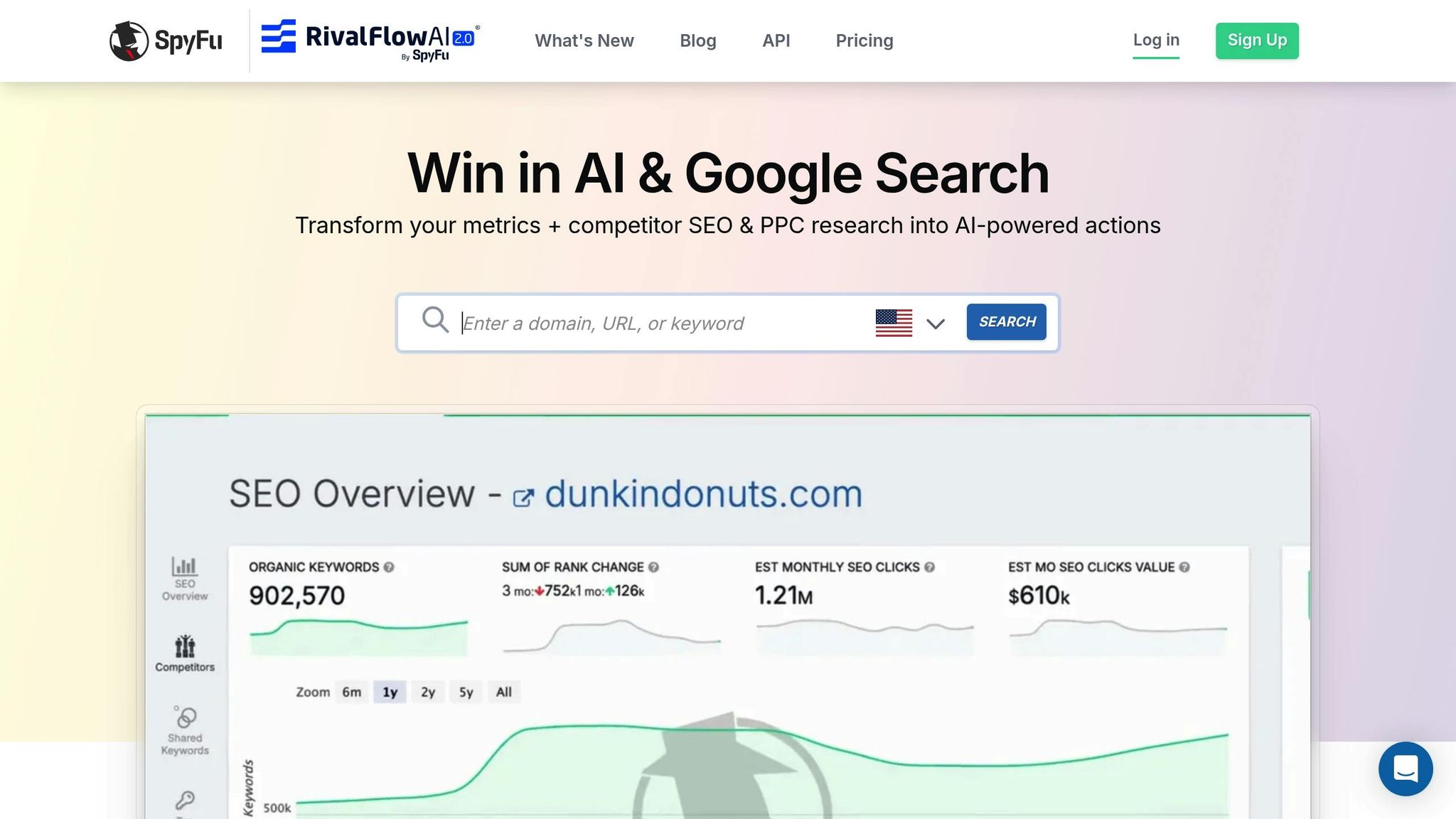
SpyFu is a reverse-engineering powerhouse, offering unlimited searches across a massive database of 13.1 billion keywords, 152 million websites, and 18 years of historical data. It's an excellent tool for uncovering long-term competitor strategies and gaining detailed insights into keywords and backlinks.
Keyword Analysis
SpyFu's Kombat feature lets you compare your domain with up to three competitors, making it easy to identify keyword gaps. The platform tracks 10 times more PPC keywords and twice as many organic rankings as many competitors, with SERP data refreshed every 15 seconds. Its SEO Ranking History tool allows you to trace a page's performance for specific keywords over time, helping you spot when traffic dips coincide with competitor actions or Google updates. For content optimization, RivalFlow AI identifies questions your competitors are answering that you’re not, and even generates AI-powered copy to fill those gaps. Plus, with SpyFu GPT, you can stream SpyFu data directly into ChatGPT, turning raw metrics into actionable strategies.
Backlink Insights
SpyFu prioritizes quality over quantity when it comes to backlinks, focusing on "kingmaker" links - highly relevant sites that carry significant ranking power. The Backlink Kombat feature shows you which sites link to multiple competitors but not to you, helping you uncover high-value opportunities. You can also search by keyword to find the exact backlinks that give competitors an edge. With a database of over 1 trillion verified, Google-indexed links, SpyFu ensures all data is safe and reliable. Built-in outreach tools even provide contact details for site owners, making it easier to build relationships and secure links.
Pricing
SpyFu's pricing is designed around unlimited data access, making it a cost-effective choice for those who need robust tools. The Basic plan starts at $39/month (or $29/month when billed annually), offering 10,000 row search results, 5,000 tracked keywords, and 10 automated reports. The Pro + AI plan is $119/month (or $89/month annually), featuring unlimited search results and exports, 15,000 tracked keywords, and RivalFlow AI for one site. For agencies or teams, the Team/Agency plan costs $249/month (or $187/month annually), supporting 5 users, 50,000 tracked keywords, RivalFlow for up to 10 sites, and API access. All plans come with a 30-day money-back guarantee.
"The data keeps me subscribed. Rank tracking, keyword research, and ad reverse-engineering uncover opportunities and expand market share."
– William N., President
5. Moz Pro
Moz Pro brings a data-driven edge to competitor analysis by zeroing in on the rivals that genuinely affect your search rankings. Its True Competitor tool identifies these key players by analyzing your top 500 keywords and scoring the 25 strongest competitors using a unique Rivalry score (1–100). This score is based on factors like Domain Authority, keyword overlap, and search volume.
Keyword Analysis
The Keyword Gap tool is designed to uncover opportunities by comparing your site with up to three competitors. It identifies areas where your site ranks lower in the top 20 or is absent altogether. To help prioritize, the Traffic Lift metric estimates potential traffic gains if you surpass a competitor's position. With AI-powered features, Moz Pro analyzes search intent and even auto-generates content briefs to help you create content that outshines the competition. You can dig into keyword gaps at different levels - whether it's the domain, subfolder, or specific page - allowing for highly targeted optimizations.
"Moz's Keyword Explorer neatly ties together keyword research metrics and makes complex analysis easy so we can spend less time in spreadsheets and more time generating qualified website traffic." – Sean, Director, Demand Generation & Customer Acquisition, Virtru
To complement its keyword tools, Moz Pro also delivers advanced insights into backlinks.
Backlink Insights
The Link Intersect tool helps you discover domains that link to your competitors but not to you, offering a clear roadmap for link-building opportunities. Moz Pro evaluates link quality using metrics like Domain Authority, Page Authority, inbound link counts, and a proprietary Spam Score. Its link reclamation feature simplifies the process of identifying and restoring lost link equity by filtering top pages by status code.
Pricing
Moz Pro offers a solid balance of features and affordability for businesses. Plans start at just $49/month ($39 when billed annually), which is nearly 65% less than many competitors that begin around $139/month. The Standard plan ($99/month or $79 annually) includes 3 campaigns, 300 tracked keywords, and 50 competitive research queries per month. For those needing more, the Medium plan ($179/month or $143 annually) expands to 10 campaigns, 1,500 keywords, and 75 competitive research queries. AI-powered tools like AI Content Briefs and Search Intent analysis are included across all plans at no extra charge. Additional user seats are available for $49/month each.
"Moz Pro gives us the data we need to justify our projects and strategies. It helps us track the ROI of our efforts and brings significant transparency to our industry." – Jason Nurmi, Marketing Manager, Zillow
Strengths and Weaknesses
Here’s a breakdown of the main strengths and weaknesses of each tool based on our detailed comparison.
Every tool shines in its own way while also having some limitations. Semrush stands out as a robust all-in-one platform, especially with its AI Visibility Toolkit, which monitors brand mentions across platforms like ChatGPT, Gemini, Claude, and Perplexity. However, this extensive feature set comes at a price - literally. The platform is not only expensive but also has a steep learning curve, and unlocking its full potential often requires costly add-ons.
Ahrefs is highly regarded for its exceptional backlink data and user-friendly interface. Its vast link index allows for detailed competitive analysis and content gap identification. That said, its credit-based pricing can quickly add up for users with high-volume needs.
Similarweb is unmatched when it comes to market-level insights. It’s perfect for understanding competitive positioning across entire markets, making it a go-to for strategic planning. However, its high starting price caters more to enterprise-level budgets.
SpyFu offers great value for those on a tighter budget. It provides generous - or even unlimited - data exports with its paid plans. It’s particularly effective for analyzing competitors’ PPC strategies and historical keyword performance. On the downside, it lacks the depth in technical audits and comprehensive data sets offered by more premium tools.
Moz Pro focuses on simplifying competitor analysis by highlighting the rivals that directly impact your rankings. Its beginner-friendly design and easy-to-understand metrics make it a solid choice for quick Domain Authority (DA) checks and SEO newcomers. However, it has a smaller backlink index compared to its pricier competitors.
Here’s a quick summary of their strengths and weaknesses:
| Tool | Core Strength | Primary Weakness | Best For |
|---|---|---|---|
| Semrush | All-in-one marketing suite & AI tracking | Expensive with a steep learning curve | Comprehensive marketing insights |
| Ahrefs | Industry-leading backlink data | Credit-based pricing; lacks automation | Deep competitor analysis |
| Similarweb | Market-level audience and traffic insights | High starting cost | Enterprise-level strategy |
| SpyFu | Budget-friendly with unlimited exports | Limited technical audit capabilities | PPC and keyword performance |
| Moz Pro | Beginner-friendly with accessible metrics | Smaller backlink database | Quick checks & SEO beginners |
Conclusion
Selecting the right AI-powered SEO tool comes down to your specific goals and budget. As we approach 2026, SEO strategies will increasingly rely on AI-driven insights that go beyond traditional ranking metrics. Our breakdown of Semrush, Ahrefs, Similarweb, SpyFu, and Moz Pro highlights how each tool serves different needs across various business sizes and objectives.
For small businesses and startups, affordability is key. Tools like SpyFu, starting at just $39/month, offer reliable PPC and keyword insights. Similarly, Moz Pro begins at $49/month, providing easy-to-understand metrics and features designed for SEO beginners.
Larger organizations handling vast amounts of data often require more robust platforms. Semrush and Similarweb deliver the depth needed for advanced market analysis. Semrush, for instance, tracks a staggering 21 billion keywords and 43 trillion backlinks, while Similarweb monitors over 1 billion websites and 8 million apps. These tools, though priced higher - such as Semrush Business at $499.95/month - are tailored for enterprises seeking strategic market insights.
For individual marketers and agencies, mid-range solutions strike a balance between functionality and cost. Ahrefs, at approximately $129/month, shines in areas like backlink analysis and competitive research. This makes it a great choice for growing teams that need detailed insights without the hefty price tag of enterprise tools.
A modular approach might work best for many users. By combining a core research tool with features for content optimization and AI visibility tracking, you can build a stack tailored to your needs. With 82% of enterprise SEO experts planning to increase their investment in AI tools by 2026, choosing a platform that aligns with your strategy is more important than ever. Prioritize the features that support your goals to stay competitive in this evolving, AI-driven SEO landscape.
FAQs
What should I consider when choosing an AI-powered SEO tool?
When choosing an AI-powered SEO tool, it's essential to focus on features that match your objectives. Look for tools that provide keyword research, content optimization, rank tracking, and AI-driven insights to refine your strategy. Seamless integration with platforms like Google Analytics or Google Search Console can also streamline your workflow and enhance data accuracy.
Budget is another critical factor. Make sure the tool fits within your financial plan without compromising on must-have features. Many tools offer free trials or basic plans, giving you a chance to explore their capabilities before making a commitment. An intuitive interface is equally important - it can reduce the learning curve and help you work more efficiently. Lastly, prioritize tools that deliver clear, actionable insights and include competitor analysis features, so you can maintain a competitive edge in the ever-changing SEO landscape.
How can AI insights improve traditional SEO strategies?
AI brings a fresh perspective to SEO by providing precise, real-time data analysis through tools like natural language processing (NLP) and machine learning. These advanced technologies make it easier to spot keyword opportunities, study competitor tactics, and fine-tune content for better performance.
For instance, AI can simplify tasks such as grouping keywords, identifying content gaps, and suggesting internal links, all of which help improve search rankings. On top of that, AI tools enable marketers to quickly adjust to shifts in search engine algorithms or AI-driven updates, keeping strategies on point. By automating repetitive tasks, AI not only saves time but also allows teams to focus on creative and strategic aspects, making SEO efforts both efficient and effective.
What is the best AI SEO tool for small businesses with a limited budget?
For small businesses operating on a limited budget, finding an AI SEO tool that balances cost with essential features is crucial.
Platforms offering free trials or affordable plans can be a game-changer. Some tools deliver powerful features - such as keyword tracking, competitor analysis, and content optimization - at prices that won’t strain your budget. Prioritize tools that are not only cost-effective but also user-friendly, ensuring you can maximize their potential without needing extensive technical expertise. This way, you can enhance your SEO efforts without overspending.