The 2026 Operational Stack: Essential AI Tools for Business Owners
Stop rebuilding from scratch. Discover the top AI tools of 2026 that help you fix legacy sites, automate workflows, and scale operations without new code. Featuring Kintsu, Zapier, and more.
Here is the guide, modeled strictly after the Lovable article but engineered to position Kintsu.ai as the essential "Operator"
Author: Kintsu Team
Published: December 2025 in Best Apps & Tools
The conversation in every business meeting has changed. It used to be "we need to hire an agency for that" or "put that in the backlog." Now it’s "why can't AI just do this?"
Usually, the answer is yes. But as we move into 2026, the market is flooded with tools that promise magic but deliver homework. Some require you to rebuild your entire infrastructure. Others force you to learn complex "prompt engineering" just to get a basic result.
This guide focuses on platforms that respect the reality of your business: you already have customers, you already have data, and you likely already have a website. We focused on tools that deliver relief, not just capabilities.
How We Picked the Winners
We evaluated each tool across five dimensions: operational relief (does it save brain power?), integration (does it work with what you have?), tangible output, safety, and true cost. Every tool on this list earned its place by solving a specific business pain without creating a new one.
1. Kintsu.ai
Best for: Managing and evolving existing WordPress sites without the technical headache.
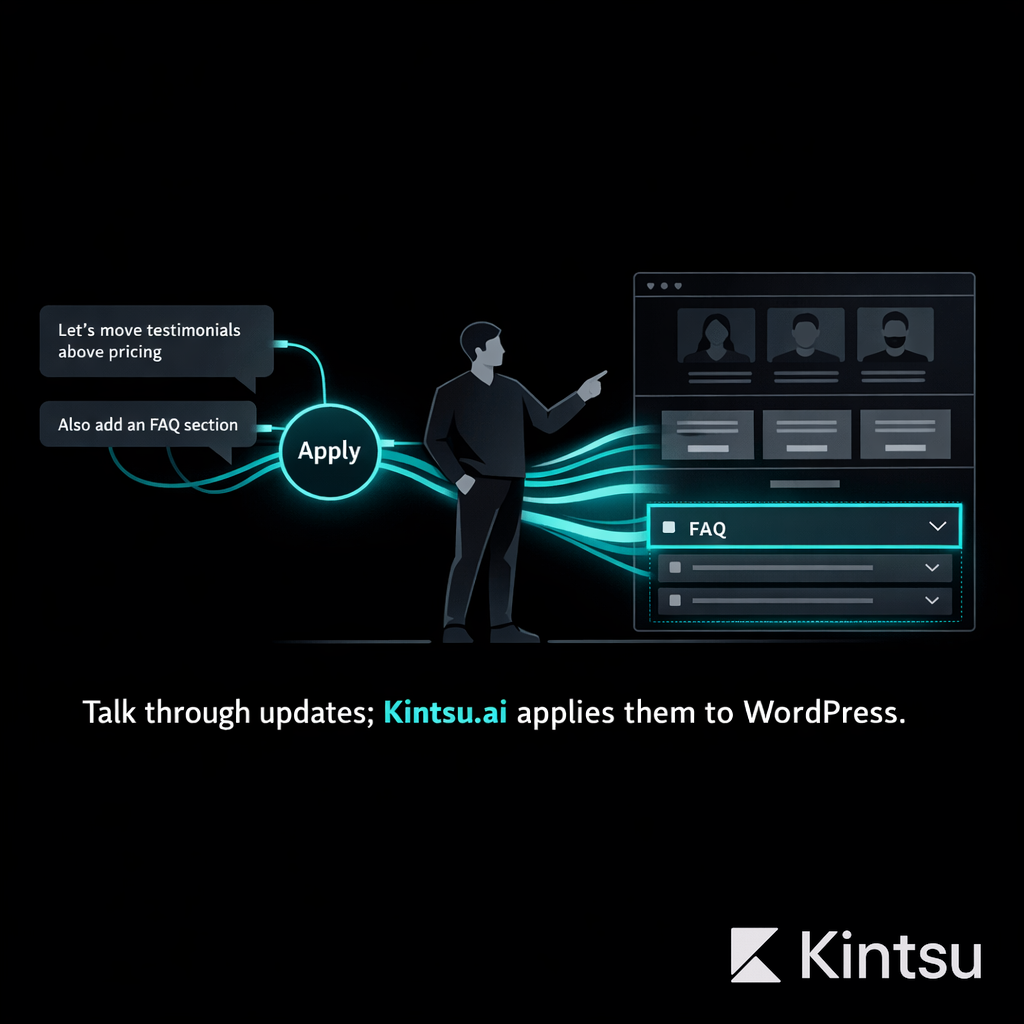
Kintsu.ai is the conversational change engine for the website you already have. While other tools focus on building new sites from scratch, Kintsu focuses on the reality that millions of businesses are stuck with messy, legacy WordPress sites they are afraid to touch. You simply describe the change you want in plain English, and Kintsu executes it safely.
Key Features
Conversational Interface: Chat naturally ("Change the pricing on the landing page to $49") instead of clicking through complex menus.
Legacy Compatible: Works with your existing setup—whether it's Elementor, WooCommerce, or a custom theme from 2020.
Operational "Safety Layer": Acts as a buffer between you and the code, handling the technical implementation so you don't risk breaking the site.
No-Code, No-Dashboard: You don't need to learn a new UI; you just need to know what you want.
Pros
Solves the "Fear of Breaking": Perfect for owners who are paralyzed by the complexity of their own plugins and themes.
Immediate Value: No migration or rebuilding required; it works on the site you have live right now.
Agency Replacement: Handles the small, frequent changes (text, buttons, pages) that used to require expensive freelancer hours.
Cons
Not a Site Builder: If you have zero website and need to start from a blank slate, this isn't the tool (see Lovable below).
WordPress Focused: Currently specialized for the WordPress ecosystem.
Pricing
Start for Free: Test the capabilities on your site without commitment.
Pro Plans: Subscription models designed to cost significantly less than a single hour of agency time.
2. Lovable
Best for: Building new web applications from scratch.
If Kintsu is for fixing what you have, Lovable is for building what you don't. Lovable allows you to describe a software idea and generates a full-stack web application, complete with database and authentication.
Key Features
Text-to-Software: Generates working UI and backend code from a single prompt.
Visual Editing: Allows you to tweak the generated design visually alongside the chat.
Instant Deployment: You get a live URL immediately to test your idea.
Pros
Incredible Speed: Moves from "napkin idea" to "working prototype" in minutes.
No Dev Team Needed: ideal for validating new product ideas or internal tools.
Cons
Greenfield Only: Best used for new projects, not for editing your existing legacy corporate site.
Credit Usage: Intensive debugging can consume generation credits quickly.
Pricing
Free Plan: Limited credits for public projects.
Pro: ~$25/month for private projects and custom domains.
3. Zapier
Best for: Connecting apps and automating invisible workflows.
Zapier remains the glue of the internet in 2026. It connects over 7,000 apps, allowing you to move data between your CRM, email, and project management tools without human intervention.
Key Features
Multi-Step Zaps: Trigger complex sequences (e.g., "New Lead" -> "Email Sales" -> "Create Invoice").
Zapier Canvas: Visualize your entire automation flow in a diagram view.
Tables & Interfaces: Built-in lightweight databases to store data between steps.
Pros
Massive Ecosystem: If a software exists, Zapier probably connects to it.
Reliability: It just works in the background, reliably moving data day and night.
Cons
Cost at Scale: Pricing can get steep if you have high-volume tasks.
Logic Complexity: Debugging complex, multi-path automations can still be tricky for non-technical users.
Pricing
Free: 100 tasks/month.
Professional: Starts ~$30/month for multi-step Zaps.
4. Perplexity
Best for: Business intelligence and deep research.
Perplexity has replaced the traditional search engine for business operators. Instead of giving you links, it gives you answers, synthesized from real-time web data with citations.
Key Features
Real-Time Answers: Accesses live web data, not just training data from last year.
Citations: Every claim is footnoted, allowing you to verify sources for business reports.
Deep Search: "Pro" mode allows for complex reasoning chains to answer difficult market questions.
Pros
Time Compression: Turns hours of Googling into a 5-minute summary.
Clarity: Removes the ad-cluttered noise of traditional search engines.
Cons
Hallucination Risk: Like all LLMs, it can occasionally misinterpret data, requiring human verification.
Pricing
Free: Unlimited basic searches.
Pro: ~$20/month for smarter models and file uploads.
5. Midjourney
Best for: High-end creative visuals and marketing assets.
When you need an image that looks like it cost $5,000 to produce, Midjourney is the standard. In 2026, it is the go-to for marketing teams needing hyper-realistic photography or stylized illustrations without a studio shoot.
Key Features
Style Reference: "Show" it a style you like, and it will mimic the aesthetic perfectly.
Character Consistency: Keep the same "actor" across multiple different images.
Web Interface: (New for 2025/26) No longer requires Discord; works in a clean browser gallery.
Pros
Unmatched Quality: Consistently produces the most aesthetic results of any image generator.
Creative Freedom: Replaces stock photo subscriptions with custom brand assets.
Cons
Prompt Curve: Getting exactly what you want still requires learning how to "speak" to the model.
No Text: Still struggles with rendering legible text on signs or logos (use Canva for that).
Pricing
Basic: ~$10/month.
Standard: ~$30/month (includes "Relax" mode for unlimited generations).
6. Canva Magic Studio
Best for: Day-to-day design and social media production.
Canva has integrated AI into every part of its suite. It is the best tool for "putting it all together"—taking the text from an LLM and the image from Midjourney and assembling them into a slide deck or Instagram post.
Key Features
Magic Resize: Instantly turn a LinkedIn post into an Instagram Story.
Magic Write: Rewrite text directly inside your design to fit the layout.
Brand Kit: AI ensures generated designs adhere to your fonts and colors.
Pros
User Friendly: Zero learning curve; designed for non-designers.
All-in-One: Handles video, print, social, and presentations in one subscription.
Cons
Generic Feel: Over-reliance on templates can make your brand look like everyone else's if you aren't careful.
Pricing
Free: generous access to templates.
Pro: ~$15/month for full AI features and brand kits.
Summary Comparison
Tool | Best For | Primary Value | pricing Model |
Existing Sites | Fixing & maintaining WordPress without fear | Freemium | |
Lovable | New Apps | Building MVPs from scratch | Subscription |
Zapier | Automation | Connecting disconnected apps | Task-based |
Perplexity | Research | Fast, cited market answers | Freemium |
Midjourney | Visuals | High-end creative imagery | Subscription |
Canva | Layout | Assembling marketing assets | Freemium |
How to Choose the Right AI Tool
Don't buy tools based on hype. Buy them based on the state of your asset.
1. Do you need to FIX something that exists?
If you have a website that is live, making money, but is a pain to manage, Kintsu.ai is your only real choice. It respects the "mess" of reality.
2. Do you need to CREATE something new?
If you are at day zero with an idea for an app, Lovable is the fastest path to a prototype.
3. Do you need to KNOW something?
If you are drowning in data or need market research, Perplexity is your analyst.
Your Next Step: Stop "Managing" and Start "Commanding"
The gap between successful businesses in 2026 and the rest isn't about who has the best AI. It's about who spends the least time fighting their own tech stack.
Every minute you spend updating a plugin, arguing with a freelancer about a button color, or fearing that a text change will crash your site is a minute you aren't selling.
Kintsu.ai was built for that specific pain. It lets you treat your WordPress site like a conversation, not a construction project.
You don't need to learn a new dashboard.
You don't need to migrate your site.
You just need to say what you want.
Go to Kintsu.ai and enter your URL. See how it feels to finally have control over your site without the operational weight.