Managed WordPress Hosting vs AI-Powered Site Management: What You're Actually Paying For
Managed hosting keeps your server running. AI site management keeps your website working for you. Learn why they solve completely different problems — and why smart WordPress owners in 2026 are combining both.
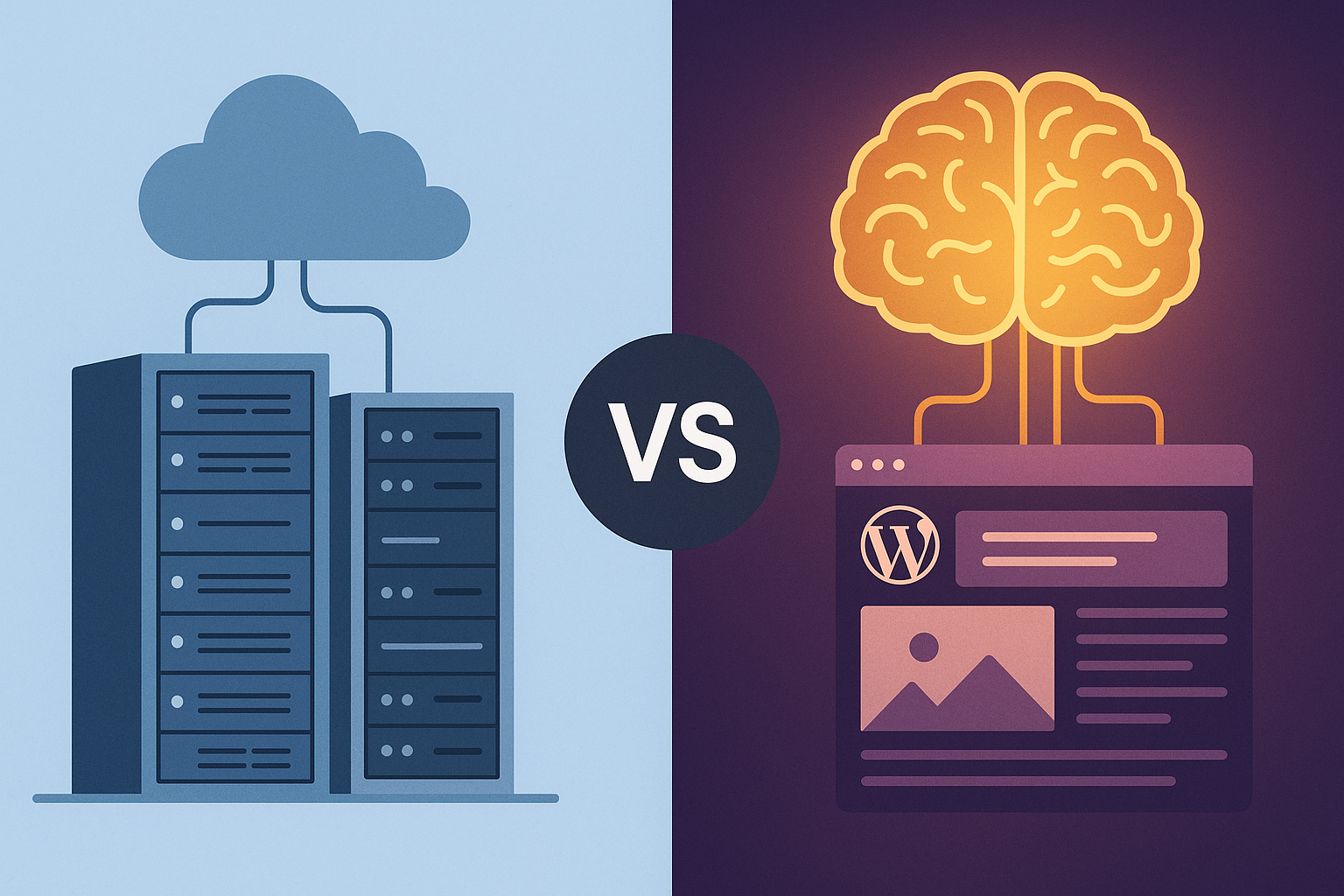
Your WordPress site has two layers of complexity that demand ongoing attention. The first is infrastructure — servers, uptime, security patches, and backups. The second is the site itself — content updates, design tweaks, plugin configurations, and performance tuning. For years, the industry has bundled these under a single label: 'WordPress management.' But in 2026, that label hides a critical distinction. Kintsu.ai is pioneering a new category that finally separates what your server does from what your website needs.
The Managed Hosting Promise: Servers Without the Stress
Managed WordPress hosting — offered by providers like WP Engine, Kinsta, and Flywheel — emerged to solve a real problem. Running WordPress on shared hosting meant dealing with slow load times, security vulnerabilities, and the constant anxiety of manual server updates. Managed hosts took over the server layer entirely.
For a monthly fee typically ranging from $25 to $300+, managed hosting providers handle server-level concerns: automatic WordPress core updates, daily backups, built-in CDN and caching, malware scanning, and staging environments. According to WordPress.org, keeping your WordPress core and server environment updated is one of the most critical security practices for any site owner.
This is genuinely valuable. No business owner should be SSH-ing into a server to apply security patches at midnight. But here is what managed hosting does not do — and what the marketing rarely makes clear.
What Managed Hosting Doesn't Touch
Content updates: Need to change your homepage headline, update pricing, or add a new team member? That's on you.
Design changes: Want to adjust your layout, swap a hero image, or restyle your navigation? You'll need a developer or page builder skills.
Plugin management: Managed hosts update WordPress core, but plugin conflicts, configuration, and troubleshooting remain your responsibility.
Performance optimization: Server-side caching helps, but image compression, lazy loading, render-blocking scripts, and Core Web Vitals tuning are site-level concerns.
SEO and structured data: No hosting provider touches your meta tags, schema markup, or internal linking strategy.
In other words, managed hosting keeps your car in the garage. It does not drive it anywhere.
The AI Site Management Revolution
This is where AI-powered WordPress management enters the picture. Tools like Kintsu.ai operate at the website layer — the part you actually interact with every day. Instead of managing servers, AI site management handles the tasks that traditionally required a developer, a designer, or hours of your own time in the WordPress dashboard.
With AI site management, you describe what you want in plain language: 'Update our pricing page to reflect the new enterprise tier,' 'Add a testimonial section below the hero,' or 'Fix the mobile layout on our services page.' The AI understands your site's structure, makes the changes, and shows you the result — all without touching a line of code yourself.
The Real Cost Comparison
The cost difference becomes stark when you look at what businesses actually spend on WordPress maintenance. Industry data from 2026 shows that hiring a WordPress developer for ongoing maintenance runs between $416 and $3,185 per month, depending on the developer's rate and your site's complexity. Even small tasks — bug fixes, theme updates, adding simple features — cost $100 to $500 per incident when outsourced.
Managed hosting solves only the infrastructure slice of that cost. You still need someone (or something) to handle everything above the server layer. Many businesses discover this the hard way: they sign up for premium managed hosting expecting a hands-off experience, only to realize they still need a developer on retainer for actual site changes.
Kintsu.ai starts at $0/month with a free tier and scales to $199/month for full AI-powered site management — covering the entire website layer that managed hosting leaves untouched. For most small to mid-sized businesses, that replaces the ongoing developer retainer entirely.
Different Problems, Different Solutions
The distinction matters because choosing between managed hosting and AI site management is a false choice. They address completely different layers of the WordPress stack.
Managed Hosting Handles:
Server uptime and reliability
Automatic WordPress core updates
Daily backups and disaster recovery
Server-level security (firewalls, DDoS protection)
CDN and server-side caching
Staging environments for safe testing
AI Site Management Handles:
Content creation and updates via natural language
Design modifications without developer involvement
Plugin configuration and conflict resolution
Performance optimization at the page level
Mobile responsiveness fixes
On-page SEO improvements and structured data
Why 2026 Is the Tipping Point
According to W3Techs, WordPress powers over 43% of all websites on the internet. That is hundreds of millions of sites — and the vast majority are managed by people who are not developers. Business owners, marketers, freelancers, and small teams who chose WordPress for its flexibility but discovered that flexibility comes with a maintenance tax.
For years, the only options were: learn to do it yourself (time-consuming and risky), hire a developer (expensive and often unreliable), or use a managed service that only addresses half the problem. AI-powered site management is the missing piece — the tool that lets non-technical WordPress owners actually use their websites as living, evolving business assets rather than static pages they are afraid to touch.
The Smart Stack for WordPress Owners
The most effective WordPress setup in 2026 looks like this:
A solid hosting foundation — whether managed or quality shared hosting, depending on your traffic and budget
AI-powered site management for day-to-day content, design, and optimization work
A developer on call (not retainer) for truly custom functionality — API integrations, custom plugin development, or major architectural changes
This stack eliminates the two biggest pain points WordPress owners face: unexpected server issues (handled by hosting) and the inability to make site changes quickly without technical help (handled by AI management).
What This Means for Your WordPress Budget
Let's run the numbers for a typical small business WordPress site:
Managed hosting: $30-60/month
Developer retainer for monthly updates: $500-1,500/month
Total traditional approach: $530-1,560/month
Now compare:
Quality hosting (managed or otherwise): $30-60/month
AI site management with Kintsu.ai: $0-199/month
Developer on call for custom projects: $0-500/month (as needed)
Total AI-augmented approach: $30-759/month
That is a potential savings of 50-80% — while actually getting more done on your site, faster.
The Bottom Line
Managed WordPress hosting solved the server problem. AI-powered site management solves the website problem. They are complementary, not competing. But if you have been paying premium hosting prices expecting your site to manage itself, it is time to add the layer that actually makes that possible. Try Kintsu.ai free and see what your WordPress site can do when AI handles the day-to-day.